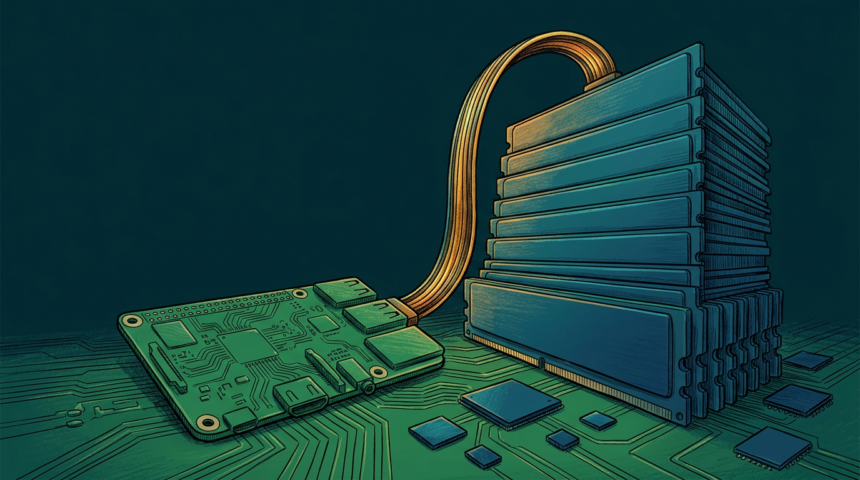
Raspberry Pi posted a record first half, and the balance sheet shows why. Revenue for the six months to June 30 reached $256.9M, up 90 percent from $135.5M a year earlier, while pre-tax profit more than tripled to $19.6M.
The Cambridge company shipped 4.2M boards, a 17 percent year-on-year gain, and its order backlog doubled to 2.6M units. CEO Eben Upton credits a decision taken in the prior financial year to build a significant strategic memory inventory, which kept product available while smaller competitors struggled to secure allocation.
Buying early paid twice. Raspberry Pi spent much of the half consuming memory purchased at friendlier prices, and gross profit per board climbed from $8 to $12.20. Total gross profit rose 79 percent to $59.4M.
That tailwind is fading. The company says the “exceptional unit economics” have moderated as the cheap stock ran down, and rebuilding inventory now costs far more. Memory held in stock averaged $13.30 per gigabyte at the end of June, against $3.60 per gigabyte at the close of 2025.
Raspberry Pi has kept buying anyway. It held 2.4M LPDDR4 devices, or 5.8M gigabytes, in June and had grown that to 8.3M gigabytes by the end of August, roughly three months of demand for the products that use it.