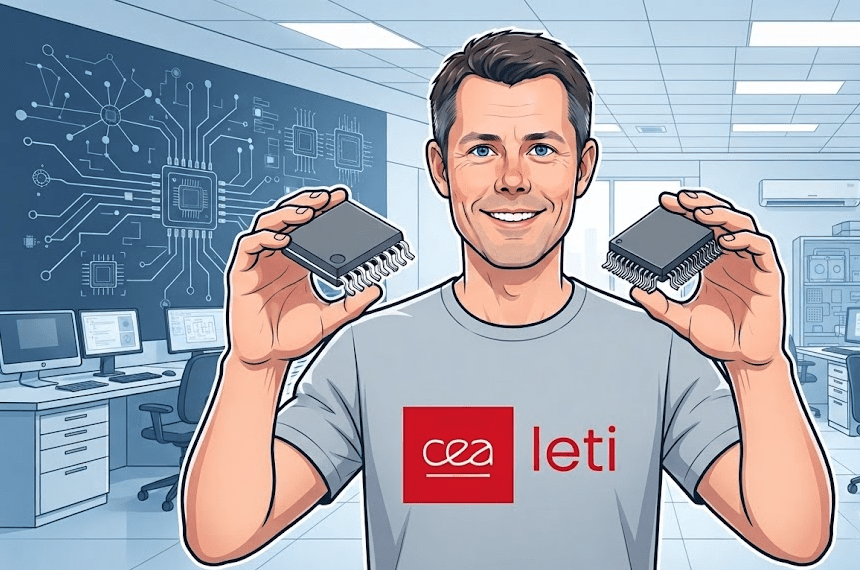
French research institute CEA-Leti is betting that emerging memory technologies such as FeRAM will find their place alongside SRAM, DRAM, and NAND flash rather than replace them outright. Francois Andrieu, head of the memory lab and a Leti fellow, told EE Times that AI workloads are creating demand for a richer memory hierarchy with more embedded, persistent, and energy-efficient options.
“We will not replace SRAM, DRAM, or NAND,” Andrieu said. “But there are opportunities to add new, complementary memories.”
Leti sees two parallel tracks. The first continues its long-running work on embedded nonvolatile memory for microcontroller applications, including resistive RAM with Weebit Nano and next-generation phase-change memory with STMicroelectronics. These technologies already have a foothold at 28nm and 18nm nodes.
The second track targets AI, where the bottleneck is keeping data close to compute silicon. Andrieu described FeRAM (ferroelectric RAM) as the technology showing the most industrial momentum, with recent breakthroughs in hafnium oxide-based ferroelectrics that scale below 28nm. FeRAM combines fast read speeds, low write energy, and 10-year data retention without a battery.
AI inference needs low-energy reads for model weights, persistent storage, and larger working memories near processors. Leti argues that inserting new memory types into gaps where conventional SRAM and DRAM cannot deliver the right mix of density, speed, endurance, and efficiency is more practical than attempting a wholesale replacement of today’s dominant technologies.
Leti has also explored compute-in-memory architectures that use the physics of the memory device itself to perform calculations, potentially cutting the energy cost of moving data between memory and logic.