Researchers at the University of Tokyo have demonstrated a non-volatile magnetic memory device that switches states in 40 picoseconds—roughly 1,000 times faster than DRAM—while generating minimal heat, potentially addressing critical power and cooling bottlenecks in AI infrastructure.
Switching Mechanism
The device uses an antiferromagnetic material, manganese-tin (Mn₃Sn), deposited in layered structures on silicon substrates. Instead of relying on electrical charge, it stores data via magnetic states. Ultrafast electrical pulses generate spin-orbit torque, transferring angular momentum directly into the magnetic structure to flip states without extreme temperature spikes. Simulations show temperature rises of only about 8 Kelvin during switching, contrasting sharply with prior picosecond-scale approaches that often involve hundreds of Kelvin of transient heating.
Memory Technology Context
Current memory technologies face fundamental trade-offs. DRAM stores data as charge in capacitors but requires constant refresh, consuming power even at idle. Flash memory retains data without power but switches slowly and energy-intensively. SRAM achieves fast switching but uses significant chip area and power. The industry has long sought a “universal memory” combining speed, density, persistence, and low power—a goal that becomes harder at ultrafast timescales, where brute-force heating has been a common but problematic solution.
Optical Integration Potential
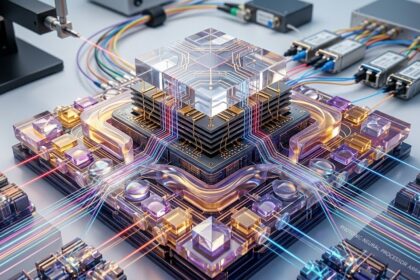
The researchers also demonstrated switching using 60-picosecond photocurrent pulses generated from a telecom-band laser and photodiode, converting optical signals directly into memory-writing electrical pulses. This aligns with broader industry trends toward optical interconnects and silicon photonics, where hyperscalers aim to move data using light rather than conventional electrical signaling.
Forward-Looking Significance
While the technology remains experimental—current devices are laboratory structures requiring external bias—the underlying mechanism offers a fundamentally different approach to digital state switching. If commercialized, it could reduce memory refresh overhead, lower cooling requirements, and blur the line between memory and storage. For AI infrastructure, the primary impact would be improved power efficiency and reduced thermal management demands across massive GPU clusters. For personal computing, it could enable instant-on systems with negligible standby power. The key insight is not merely a faster memory, but a more energy-efficient way to switch the physical states that underpin all computation.