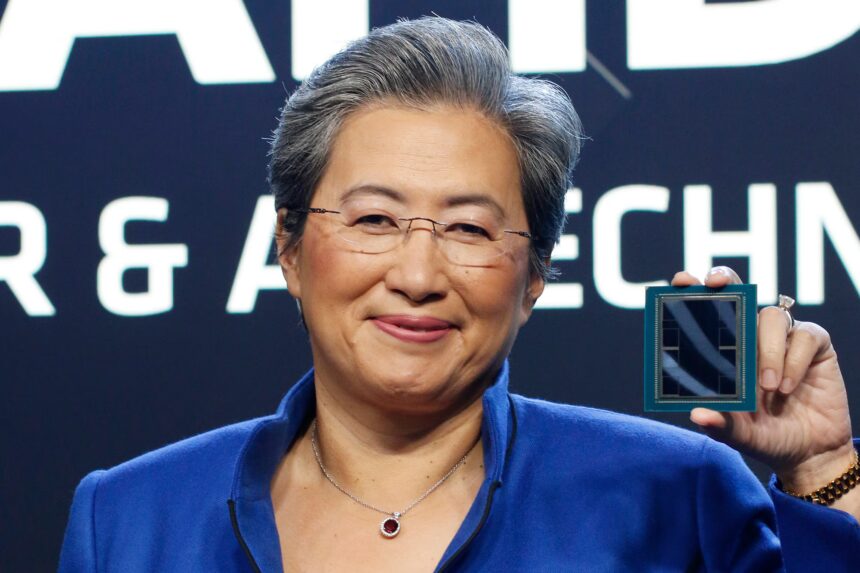
AMD CEO Lisa Su met with Chinese Vice Premier He Lifeng in Beijing on Monday, pledging deeper investment days after the Trump-Xi summit.
Diplomatic Context
Su’s meeting at the Great Hall of the People followed President Trump’s state visit to China from May 13 to 15. He Lifeng cited “balanced and positive” summit outcomes and invited multinationals, including AMD, to expand cooperation, per Xinhua News Agency.
Su was not part of the executive delegation accompanying Trump, which included Apple’s Tim Cook, Tesla’s Elon Musk, and Qualcomm’s Cristiano Amon. Nvidia CEO Jensen Huang was initially excluded but later invited personally by Trump during a refueling stop in Anchorage. He Lifeng held a separate meeting with Huang as well.
Export License Dynamics
Both AMD and Nvidia received export license approvals for China-specific chips late last year. AMD’s MI308 and Nvidia’s H20 are each subject to a 15% revenue fee, but Nvidia has struggled to convert clearance into sales—no H200 transactions have been completed with Chinese buyers, hampered by U.S. licensing bottlenecks and Beijing’s refusal to allow domestic purchases.
AMD’s MI308 shipment status remains unclear, but the company is believed to be moving forward. The more powerful MI325X—delivering 1,300 TFLOPS FP16 with 256 GB HBM3E and 6 TB/s bandwidth—shifted from a presumption of denial to case-by-case review under a Bureau of Industry and Security rule effective January 2025. That rule also covers Nvidia’s H200 and imposes a separate 25% tariff on chips transiting the U.S. before export.
Market Positioning and AI Strategy
Following her Beijing outreach, Su delivered a keynote at AMD’s AI Developer Day in Shanghai. She predicted that roughly five billion people would use AI daily by 2030 and described China as “the world’s most dynamic AI ecosystem” and a critical part of AMD’s global footprint. AMD employs over 4,000 engineers across R&D centers in Beijing, Shanghai, Shenzhen, and Taipei.
Simultaneously, AMD is scaling U.S. commitments. The company is building a gigawatt-scale data center for OpenAI, with the first phase scheduled for the second half of this year.
Forward Outlook
Maintaining access to the Chinese market while deepening its role in American AI infrastructure requires AMD to deftly navigate political currents on both sides of the Pacific. Su’s diplomatic engagement signals a calibrated strategy: securing regulatory pathways for China-specific chips, expanding engineering presence, and balancing geopolitical risk—all while advancing flagship U.S. AI projects. The outcome will test whether dual-market alignment is sustainable in an era of escalating tech rivalry.