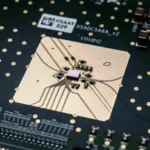

The new chip from WIN Semiconductors isn’t just another transistor shrink. It’s a targeted weapon against signal chaos. As radar and 5G systems cram more data into ever-tighter frequency bands, the biggest enemy isn’t noise—it’s distortion. WIN’s NP12-1B process, a 0.12-micron gallium-nitride (GaN) technology on silicon carbide (SiC), is built to fight that fight.
The Linearity Edge
Most power amplifiers can boost a signal, but they often mangle it in the process, creating unwanted harmonics that bleed into neighboring channels. The NP12-1B is a depletion-mode (D-mode) HEMT—a high-electron-mobility transistor—engineered specifically for high linearity. That means it can pump out serious power from K-band through V-band (roughly 18 to 75 GHz) while keeping signal distortion to a minimum. For military radar, electronic warfare, or dense urban 5G backhaul, this is the difference between a clean lock and a garbled mess.
WIN tweaked the transistor’s internals with a source-coupled field-plate design, pushing the gate-to-drain breakdown voltage to 120V. That high voltage tolerance lets the chip survive continuous-wave (CW) operation under heavy compression—think sustained high-power transmission without frying itself. It also ships with an optional Enhanced Moisture Ruggedness coating, making it viable for plastic packaging in humid environments.
Ready for the Hard Stuff
The NP12-1B isn’t just a lab curiosity. WIN has a full process design kit (PDK) with both large- and small-signal models, so engineers can start designing circuits immediately. The company claims industry-leading reliability, and it’s backing that up with a comprehensive qualification report available on request. High-volume production kicks off in Q3 2025.
As spectrum gets more crowded and signals get more complex, the ability to amplify without distorting isn’t a luxury—it’s a necessity. WIN’s NP12-1B is a bet that the future of RF belongs to chips that can handle the heat, the humidity, and the harmonics, all at once.