The first boards rolled off Wistron’s Fort Worth assembly line this week, putting the Taiwanese manufacturer’s name on a US factory for the first time and turning Nvidia’s longstanding talk of domestic AI hardware production into a measurable output.
“We don’t just need to build fast; we need to build right,” Wistron Chairman Simon Lin said during the opening ceremony, explaining the company’s patient approach to scaling its first wholly owned US factory. The D1 facility runs two parallel assembly cells — one dedicated to Nvidia’s GB300 Grace Blackwell Ultra systems, the other ready for the Vera Rubin generation that follows.
Huang contrasted the plant’s output — a single GB300 rack carries roughly 1.5 million components, weighs two tons, and sells for around $4 million — with the production line’s ability to turn them out at volumes normally associated with consumer electronics. “We’re producing them like phones,” he said.
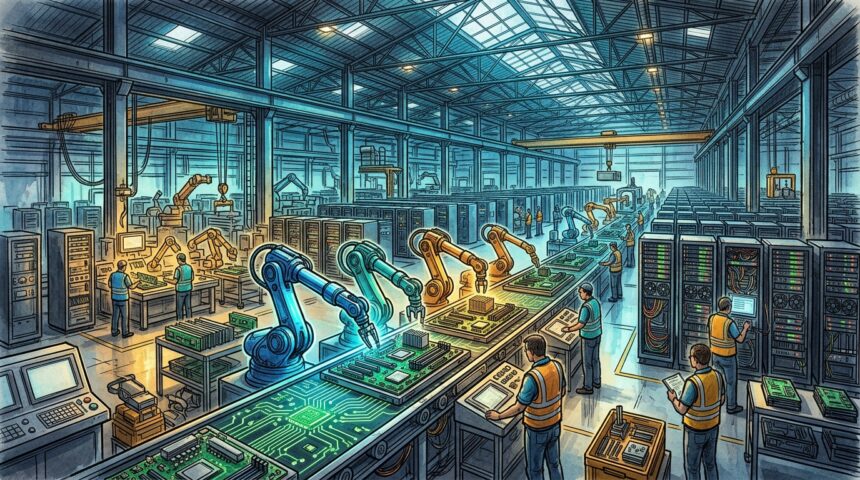
The math behind that statement is what brought Wistron to Fort Worth rather than shipping finished racks from Taiwan. A single board defect found post-shipment costs weeks in cross-Pacific return logistics. Finding it on the factory floor costs hours. The D1 facility embeds test-and-rework stations at multiple points along the assembly line, so faults are caught before a system leaves the building.
Wistron modeled the entire production flow in simulation before pouring concrete. Engineers walked through virtual assembly lines in Nvidia’s Omniverse environment, tuning robot arm trajectories and conveyor belt speeds against throughput targets, then handed those validated procedures directly to floor workers as standard operating instructions. The company says this cut the usual commissioning time by a meaningful margin.
The $700 million greenfield site currently employs roughly 500 people across engineering, manufacturing, and facilities trades. Wistron expects that number to reach 1,000 by December. The hiring pool extends beyond chip technicians — electricians, plumbers, and industrial construction workers make up a significant share of the new roles, reflecting the breadth of skills a modern semiconductor assembly plant demands.
Texas has become a preferred destination for this kind of buildout thanks to deep logistics infrastructure and a growing labor pool trained for fab-adjacent work. Foxconn and Quanta maintain nearby operations, and Nvidia has publicly projected that American factories will handle a significant share of its AI platform output over the coming years — a target the Wistron line is now helping to meet at the board level.