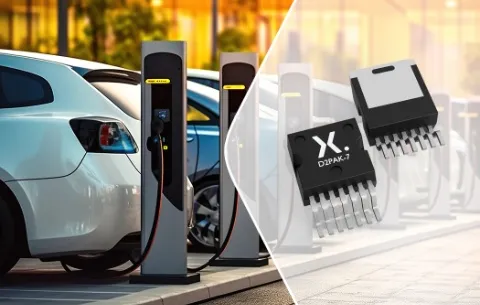
Nexperia just dropped a trio of automotive-grade silicon carbide MOSFETs that don’t just handle 1200 volts—they keep their cool while doing it.
The Dutch chipmaker’s new NSF030120D7A0-Q, NSF040120D7A1-Q, and NSF060120D7A0-Q are rated for 30, 40, and 60 milliohms of on-resistance. That’s the number that determines how much power gets turned into heat instead of motion. But here’s the real trick: while most SiC MOSFETs see their RDS(on) double as they heat up from room temperature to 175°C, Nexperia’s parts only climb 38%. That’s a massive difference when your device is bolted to a PCB and trying to shed heat through a surface-mount package.
The Heat Is On
Temperature stability isn’t just a nice spec—it’s the whole game for automotive designs. On-board chargers, traction inverters, DC-DC converters, and HVAC systems all run hot, and they all rely on efficient switching to keep range anxiety at bay. Nexperia’s D2PAK-7 package is surface-mount, which means automated assembly lines love it. But surface-mount parts cool through the board, not through a heatsink tab, so thermal performance becomes critical.
By keeping RDS(on) growth in check, Nexperia says engineers can pull more usable power from these MOSFETs than from similarly rated competitors. That translates to smaller cooling systems, cheaper passive components, and a lower total cost of ownership. As Edoardo Merli, the company’s wide bandgap chief, puts it: “Relaxed cooling requirements, more compact passive components, and higher achievable efficiency allow customers more degrees of freedom.”
What’s Next
These three parts—now AEC-Q101 certified—are just the opening act. Nexperia plans to release automotive-qualified 17mΩ and 80mΩ variants later this year. For EV designers wrestling with the trade-off between power density and thermal management, this isn’t just a minor spec bump. It’s a signal that the next generation of SiC MOSFETs will let you push harder without melting down. And in the race to build faster-charging, longer-range electric cars, that’s exactly the kind of headroom the industry needs.