Navitas just dropped a new line of silicon carbide MOSFETs that run so cool they could triple the lifespan of your next EV’s power electronics. That’s not marketing fluff—that’s physics.
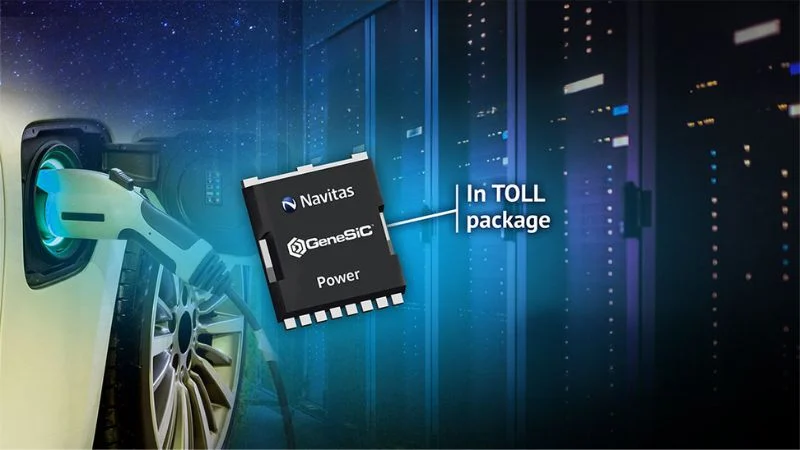
The company’s third-generation “Gen-3 Fast” SiC MOSFETs are now available in two surface-mount packages: the chunky D2PAK-7L (TO-263-7) and the sleeker TOLL (TO-Leadless). Both are AEC Q101-qualified for automotive abuse. The secret sauce is Navitas’ “trench-assisted planar” tech, which sounds like a landscaping tool but actually delivers what the company claims is world-beating performance as temperatures climb.
The Cool Factor
Here’s the headline: case temperatures up to 25°C lower than conventional SiC parts. In the high-stress world of EV traction inverters and DC-DC converters, that delta is massive. Navitas says the operating life could be *three times longer* than competing SiC products. For automakers sweating warranty costs, that’s music.
The Gen-3 Fast MOSFETs are optimized for the fastest switching speeds and highest efficiency—critical for squeezing every watt out of an on-board charger (OBC). Navitas’ own design center has already demoed a 22kW OBC solution hitting 3.5kW/liter power density and over 95.5% efficiency. That’s no lab curio; that’s production-ready.
Package Deal
The 650V parts—rated from 20mΩ to 55mΩ—target 400V battery architectures. The 1200V siblings, ranging from 18mΩ to 135mΩ, are built for the emerging 800V systems. Both voltage classes come in the traditional D2PAK-7L. But for 400V EVs, the TOLL package is the real story.
Compared to D2PAK-7L, TOLL slashes junction-to-case thermal resistance by 9%, shrinks the PCB footprint by 30%, cuts height by 50%, and occupies 60% less volume. Package inductance is just 2nH, which means cleaner switching and lower dynamic losses. Translation: you can cram more power into less space without cooking your board.
What This Means
Navitas is betting that cooler SiC means longer EV life and higher power density—a one-two punch for the next wave of electric cars. With both 650V and 1200V parts shipping now, the message is clear: the thermal bottleneck is breaking. Your next EV might not just be faster to charge; it could outlast the battery pack itself.