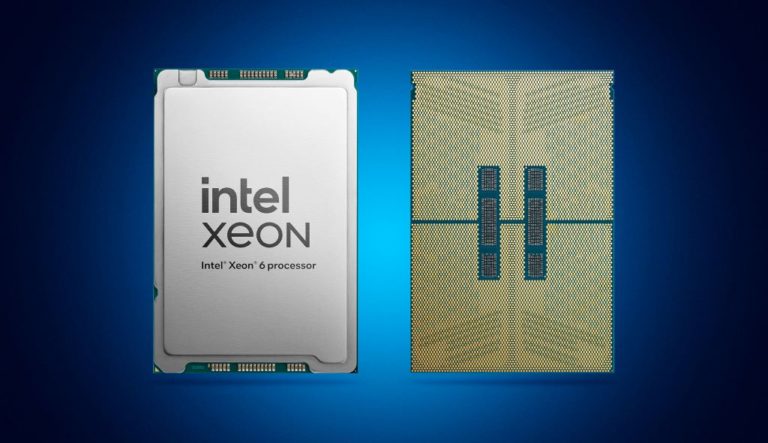
Intel has confirmed its next-generation Xeon 7 “Diamond Rapids” CPUs will launch in 2027 on the refined Intel 18A-P node, featuring PCIe 6.0, 50% higher core counts, and double the memory bandwidth of its predecessor.
Product roadmap and competitive landscape
Diamond Rapids represents Intel’s response to AMD’s upcoming EPYC “Venice” processors, built on Zen 6 architecture and still slated for release this year. Intel’s 2027 launch window gives AMD a significant time-to-market advantage in the high-end server CPU segment. The chips will succeed Granite Rapids, which topped out at 128 cores and 614 GB/s of memory bandwidth on its 12-channel configuration.
Core architecture and memory specifications
Intel has confirmed Diamond Rapids will support PCIe 6.0 and double the memory bandwidth of Granite Rapids. The company canceled an 8-channel memory variant last year to focus exclusively on a 16-channel design. With second-generation MRDIMM support, peak memory bandwidth could reach upwards of 1.6 TB/s, compared to Granite Rapids-AP’s 614 GB/s ceiling.
Core counts remain unconfirmed, but a 50% increase over the top-end 128-core Granite Rapids-AP would yield 192 cores. Rumors of 256-core and 512-core variants appear unfounded, according to Intel. The microarchitecture powering those cores is expected to be Panther Cove, an unreleased design. Intel has not yet clarified whether Diamond Rapids will support simultaneous multithreading (SMT), though the company stated in its January earnings call that it will “reintroduce multi-threading back into our data center road map.”
Manufacturing node details
Diamond Rapids will be built on Intel 18A-P, a refined version of the 18A node used for the recently launched Xeon 6+ chips. Intel claims 18A-P delivers 9% higher performance at the same power, or an 18% power reduction at equal performance, along with improved reliability and voltage behavior. This maturity is likely aimed at attracting external foundry customers.
Forward-looking conclusion
While Diamond Rapids is a critical release for Intel’s data center ambitions, the company has emphasized the importance of its successor, Coral Rapids, expected in 2028 with SMT support. Intel is actively exploring ways to accelerate Coral Rapids’ rollout. For now, AMD holds a competitive lead with its Zen 6 Venice launch imminent, but Diamond Rapids’ architectural and process improvements position Intel to close the gap in 2027.