
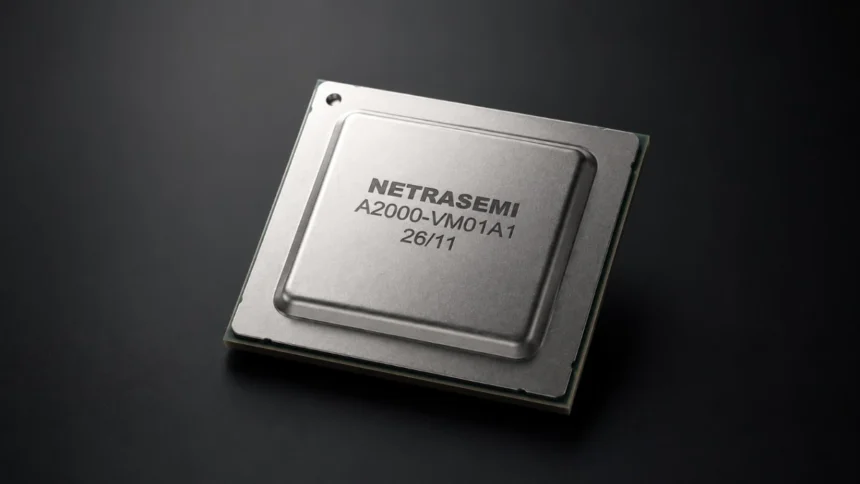
Indian startup Netrasemi has brought up its A2000 edge AI chip on TSMC’s 12-nm process and begun supplying engineering samples and development kits to select customers, marking a key milestone toward production.
Chip architecture and performance
The A2000 is Netrasemi’s first full-feature system-on-chip, delivering up to 12 TOPS of AI performance. It integrates a complete video pipeline, vision processing, and a neural processor, targeting applications such as surveillance cameras and in-cabin monitoring.
The chip is built on Netrasemi’s heterogeneous graph stream architecture, which combines in-house neural processing units, graphics processing units, vector engines, direct memory access engines, and encryption engines. This design allows multiple AI models to run simultaneously with minimal context-switching overhead.
Netrasemi licenses standard interface IPs for DDR, USB 3.0, and PCIe, while developing its core acceleration IPs internally. The A2000 uses an Arm Cortex-A processor; the company also adopts the Shakti RISC-V core for its RISC-V development efforts, citing the need for complete IP control.
Customer validation and ecosystem
The company is currently supplying evaluation kits and engineering samples, focusing on validation and reference design development rather than production silicon sales. CEO Jyothis Indirabhai emphasized that reference designs are essential for engaging OEMs and ODMs.
Netrasemi has also developed Netra Edge Studio, a software environment with sample applications, compiler tools, drivers, and supporting software. The company expects initial revenue by the end of next year as production begins.
Product roadmap and market strategy
The A2000 is the flagship of a scalable processor family. The R1000, an ultra-low-power AI microcontroller for IoT and smart sensors, was taped out in April and is expected back from fabrication in August. Both chips target production next year.
Netrasemi is also developing the R4000, a higher-performance chiplet-based processor positioned as an edge AI server-class chip. The R4000 uses a two-die chiplet architecture and shares common architectural components with the A2000 and R1000.
The company initially targets surveillance, in-cabin monitoring, automotive, and drone applications, with India emerging as a key market due to local procurement advantages and growing demand for vision-based systems. Netrasemi is evaluating Indian OSAT providers for future production.
The A2000’s successful bring-up validates Netrasemi’s in-house IP portfolio and heterogeneous architecture, positioning the startup to compete in the edge AI market with a scalable family of processors spanning microcontrollers to server-class chips.