At the China International Industry Fair in Shanghai this week, a startup called Langdao Silex pulled the cover off a component of EUV lithography that no Chinese firm has shown before: a working light source.
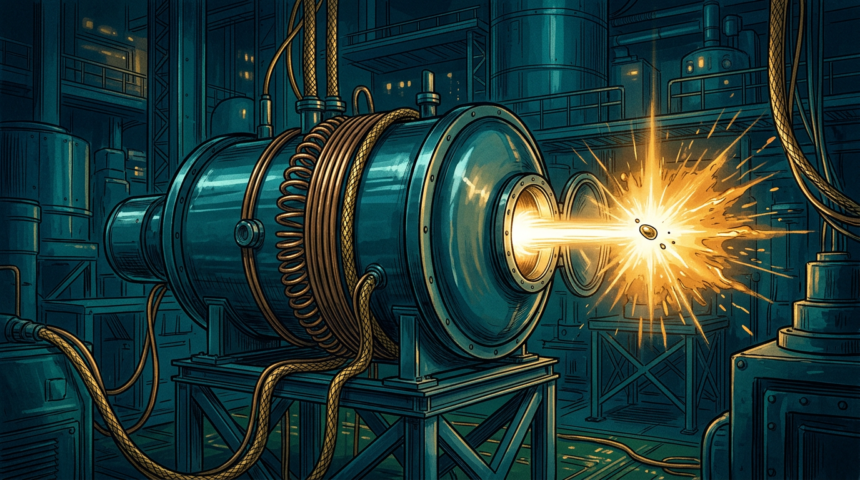
The source is a laser-produced plasma design, the same approach ASML uses. High-power lasers strike a tin droplet to create a plasma hot enough to glow in the extreme ultraviolet. According to specifications the company disclosed, the driving laser runs at 1,000W into the plasma with a repetition rate of 1 to 20 kHz and conversion efficiency above 2 percent. EUV output is quoted at 15W or better, plasma size at 60 micrometers, and continuous operation at more than 100 hours.
The startup says roughly 90 percent of the machine’s components are localized, with most core parts developed in house, according to the Jiefang Daily account of the fair. Staff described the prototype as suitable for wafer exposure testing.
Spectrometers and scans are one thing. A fab-ready source is another. Langdao puts mass production three to five years out, and that reads as an optimistic number: ASML’s own NXE light sources run hundreds of watts and have had two decades of refinement behind them, and a full scanner needs optics, precision stages and a metrology stack that China does not yet make.
The context explains the attention. Export controls have kept ASML’s EUV machines out of Chinese fabs, and Chinese lithography has been stuck at DUV. A domestic source, even a modest one, is the prerequisite for every other part of a homegrown EUV program.