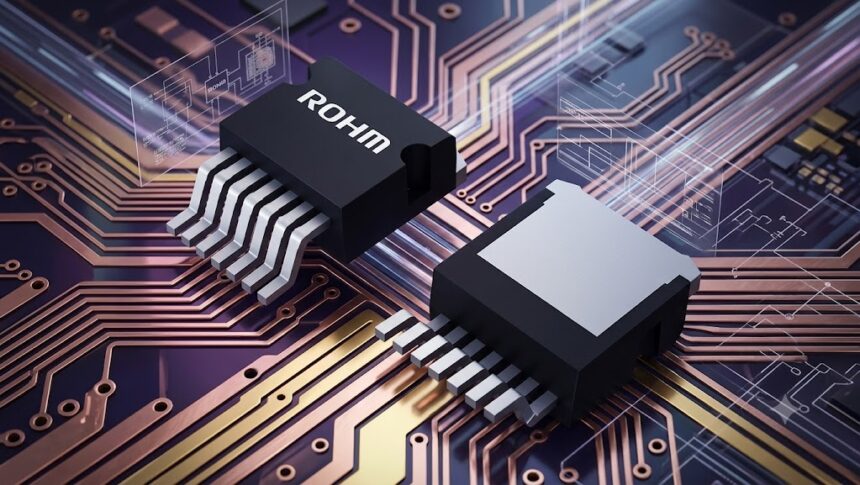
ROHM’s 750V silicon carbide MOSFET has been selected for use in battery backup units (BBUs) for AI server power supplies, marking a key shift toward high-voltage direct current (HVDC) architectures in data centers.
Market context
As generative AI workloads drive GPU performance higher, data-center power consumption is rising sharply. The industry is responding by migrating to HVDC architectures to reduce transmission losses. In these high-power, high-voltage environments, BBUs and capacitor units (CUs) are becoming critical for protecting systems and data during power outages or momentary interruptions.
Technical specifications
The adopted device, the SCT4013DLL, is a 750V SiC MOSFET installed in the power supply section of a ±400V power architecture for AI servers. It offers a maximum junction temperature of 175°C, enabling stable operation even as heat generation increases with higher voltages and power density. For next-generation 800VDC power architectures, where the supply voltage to the battery pack inside the BBU reaches approximately 560V, the 750V-rated MOSFET provides sufficient headroom.
Why sic matters
HVDC power supplies for next-generation AI servers require backup systems capable of controlling high voltages and large currents instantly, with minimal power loss during abnormalities. SiC power devices combine high-voltage capability, low switching losses, and high-temperature tolerance, making them core components for power control in these demanding applications.
Forward-looking conclusion
ROHM’s adoption in AI server BBUs underscores a broader industry trend: as data centers push toward higher voltages and greater power densities, wide-bandgap semiconductors like SiC are becoming indispensable. This deployment validates SiC’s role in enabling reliable, efficient backup power for the AI infrastructure that will define the next decade of computing.