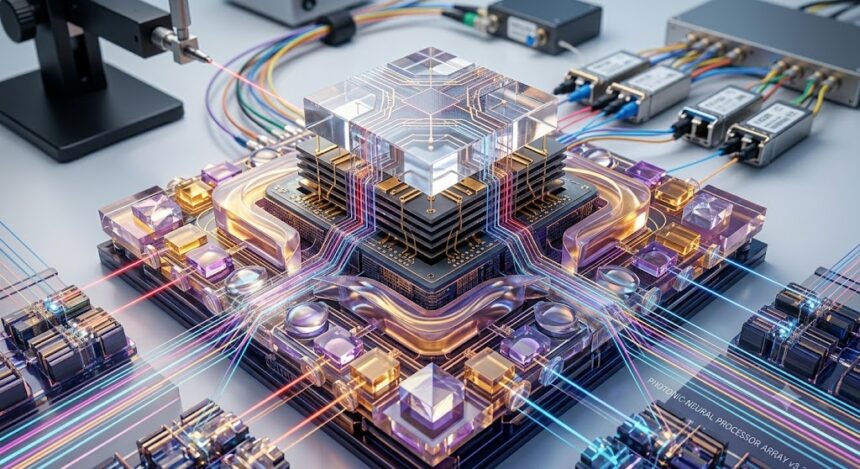
Photonics is transitioning from a telecom and long-haul networking technology to a critical infrastructure layer across the semiconductor ecosystem, driven by AI’s insatiable demand for data movement.
The system-level scaling problem
The hardest challenges in computing have shifted from transistor density to system-level performance. AI workloads—training, inference, and agentic reasoning—routinely exceed the resources of a single server, requiring clusters of accelerators to function as a unified machine. Scaling is now constrained as much by communication and memory access as by raw compute.
Copper interconnects remain viable over short distances, but as bandwidth rises and distances grow, electrical signaling incurs prohibitive penalties in loss, power, density, and complexity. Optical interconnect addresses these bottlenecks by providing higher bandwidth, lower latency, and greater reach with reduced energy per bit.
Memory becomes the critical battleground
Modern AI inference is increasingly memory-hungry. Long-context models and reasoning workloads generate large key-value caches that must be preserved and reused. Agentic AI intensifies this pressure by requiring context retention across repeated reasoning steps and support for many concurrent users.
High-bandwidth memory attached to an accelerator is valuable but finite and expensive. Protocols such as Compute Express Link (CXL) enable low-latency, coherent access to pooled and disaggregated memory. When paired with optical networking, this model transforms memory from a stranded local resource into a composable system resource across boards, servers, and racks.
Optical interconnects enable composable compute
AI workloads rely on shared memory footprints and fast communication across distributed systems. A rack of accelerators is useful only if they can be programmed and fed as a coordinated machine. Optical links and optical circuit switches excel at providing the bandwidth, latency, and topology flexibility needed to connect devices at chip-to-chip, package-to-package, and rack-to-rack levels.
Over time, this points toward data centers whose topology can be shaped around workloads rather than fixed by copper traces and static cabling. Optical computing adds another layer: photonic processors can perform matrix and vector operations with very low latency and attractive energy characteristics, though the most successful designs will pair optical processing with electronics, compilers, and application frameworks.
Beyond speed: security and interference advantages
Optical media are immune to electromagnetic interference because signals are carried by light rather than electrical current. They also do not radiate electromagnetic signals in the same way metal interconnects do. This matters in electrically noisy environments, defense applications, and medical infrastructure. While no technology is automatically secure, optical links reduce certain electromagnetic side channels and make passive interception more difficult than with conductive media.
A forward-looking conclusion
Photonics is no longer a niche technology for long-haul networks. It is becoming a foundational scaling layer for AI-era computing, addressing the system-level bottlenecks of bandwidth, latency, power, reach, and security. As data grows faster than conventional infrastructure can move it, photonics will continue expanding its role across pluggable optics, co-packaged optics, optical I/O chiplets, CXL-enabled memory fabrics, and optical accelerators. The implications extend far beyond AI, reshaping how data centers, memory systems, and next-generation workloads are architected.