Power Integrations has released two ultra-slim auxiliary power supply reference designs for NVIDIA’s Kyber 800VDC AI data center architecture, cutting board space by 30% and bill-of-materials count by a similar margin.
Design specifics
The two reference designs target the auxiliary power needs of high-voltage AI data centers. The single-output, 15W unit measures just 30mm by 30mm with a 7mm profile. The isolated, six-rail 35W version is 80mm by 60mm with an 8mm profile. Both deliver at least 88% efficiency across line and load conditions.
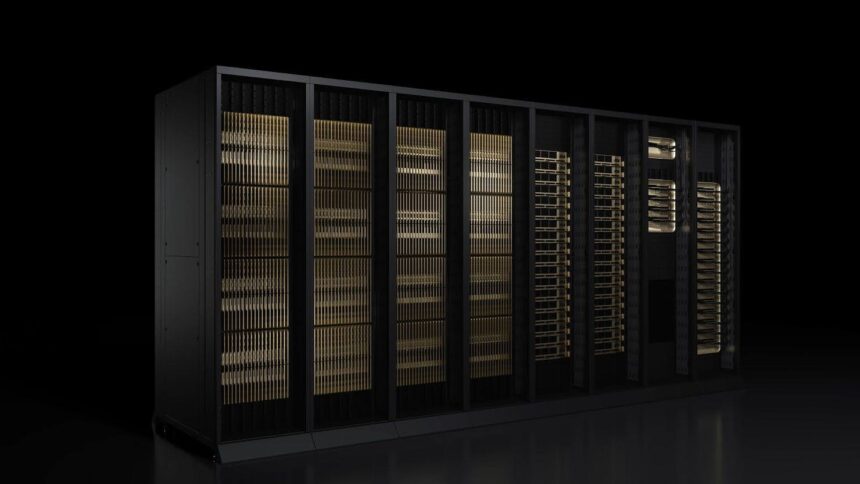
These flyback converters are optimized for the Kyber liquid-cooled, blade-rack architecture. They power critical housekeeping components—microcontrollers, gate drivers, and operational amplifiers—that ensure system reliability, efficiency, and safety.
Technology foundation
Both designs leverage Power Integrations’ InnoMux-2 ICs with 1700V PowiGaN gallium nitride technology. The 1700V rating comfortably supports 1000VDC nominal input in a flyback configuration, maintaining 90% flat efficiency in discontinuous conduction mode.
Power Integrations is the only vendor offering single-HEMT 1700V GaN devices, according to senior training manager Jason Yan. This enables compact flyback converters with wide safety margins on an 800V bus. Competing solutions rely on discrete silicon carbide components, which require 30% more components and additional board space.
Design availability
The published design example reports—DER-1110 (35W, multi-output) and DER-1114 (15W, single-output)—are available for free download from power.com. Both use the IMX2353F controller IC.
Engineers can obtain further details through Power Integrations sales representatives or authorized distributors including DigiKey, Newark, Mouser, and RS Components.
Forward-looking significance
As AI data centers push toward 800VDC distribution to improve efficiency and reduce copper losses, auxiliary power supply density becomes a critical design constraint. Power Integrations’ GaN-based approach directly addresses this bottleneck, enabling smaller, more reliable, and lower-cost power stages. This reference design release signals a broader industry shift toward wide-bandgap semiconductors in enterprise-scale AI infrastructure.