
The copper wires that stitch together today’s most powerful AI chips are hitting a wall—literally. A French startup called NcodiN just raised €16 million to replace them with light, using a laser small enough to fit on a silicon chip.
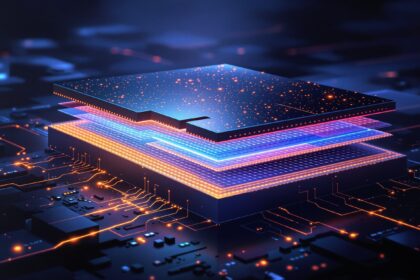
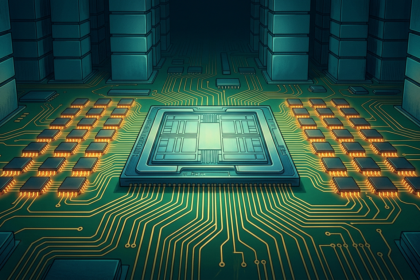
This isn’t another incremental improvement. NcodiN’s bet is on **silicon photonic interposers**—basically, a middleman layer that sits between processor chiplets and uses photons instead of electrons to shuttle data. The killer app? Breaking the memory bandwidth bottleneck that’s choking AI accelerators and GPUs as they try to feed hungry generative AI models.
The World’s Smallest Laser
At the heart of NcodiN’s tech is what it claims is the world’s smallest laser. These nanolasers are embedded directly into silicon, letting chipmakers pack supercomputer-level interconnects onto a single processor without redesigning the entire architecture. The company’s prototype links already hit record energy efficiency—below 0.1 picojoules per bit.
The seed round, led by MIG Capital with help from Maverick Silicon and others, will move NcodiN from a cleanroom proof-of-concept to a CMOS pilot line on 300mm wafers. That’s the industrial stamp of approval: proving this can be manufactured at scale, using existing fab tools.
Breaking the Copper Wall
“Memory bandwidth has become a defining bottleneck in AI,” says Josh Mine of Maverick Silicon. Copper interconnects simply can’t deliver the reach or efficiency next-gen systems need. NcodiN’s optical interposers promise to unlock bandwidth that copper can’t touch—critical for the “wafer-scale superchips” everyone from Nvidia to hyperscalers is chasing.
The company is also stacking its advisory board with silicon photonics royalty, including Eli Yablonovitch (a pioneer of photonic crystals) and former ARM exec Gus Yeung. That’s a signal this isn’t just lab science; it’s a play for the data center.
What This Means
The AI hardware race has been about cramming more transistors, then more chiplets, into a package. But the real prize is getting those chiplets to talk to each other—and to memory—fast enough. NcodiN is betting that photons, not electrons, will write the next chapter. If its nanolasers deliver at scale, the copper wall won’t just be cracked. It’ll be obsolete.