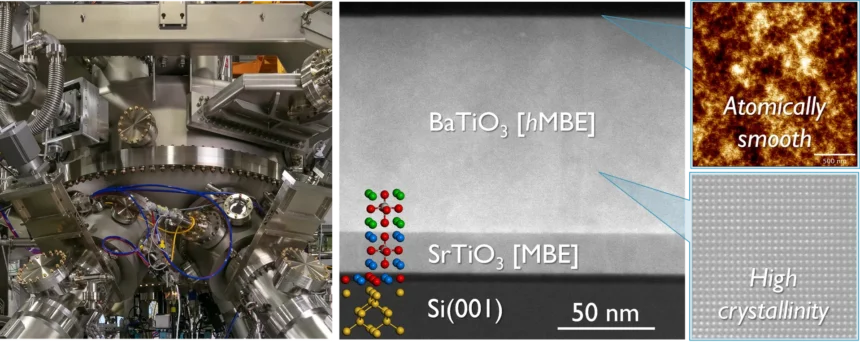
The future of high-speed data—everything from AI data centers to quantum computing—just got a critical material upgrade. Veeco and imec have cracked a manufacturing puzzle that’s been holding back a wonder material called barium titanate (BTO), proving it can be grown on 300mm silicon wafers at scale. This isn’t just a lab demo; it’s a production-ready process.
The Modulator Problem
Today’s silicon photonics modulators—the chips that convert electrical data into light—are hitting a wall. They guzzle power, take up too much space, and can’t keep pace with the exploding demand for bandwidth. The optical transceiver market alone is projected to balloon from $2.9 billion in 2024 to $13.1 billion by 2030. To hit those numbers, you need a material that can modulate light faster and with less voltage. BTO is that material, thanks to its unique electro-optic properties. But until now, growing it on silicon was too slow and too expensive for high-volume manufacturing.
MBE Gets a Makeover
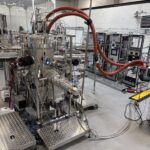
Enter molecular beam epitaxy (MBE)—historically the slow, finicky, and costly darling of research labs. Veeco’s new cluster system changes the game. It’s a 300mm platform that combines solid and hybrid MBE techniques to deposit single-crystalline BTO films on silicon with repeatability that fabs demand. “The historic view of MBE is that it’s slow and expensive,” says Matthew Marek, Veeco’s senior director of MBE marketing. “New hardware developments bring MBE into a cost-effective domain suitable for semiconductor fabs.” Imec’s Clement Merckling notes that four years of joint benchmarking on material and electro-optic properties paved the way for this scale-up.
What This Means
This isn’t just about one material. The same platform can handle strontium titanate (STO) and other beyond-silicon electro-optic crystals. Imec’s Joris Van Campenhout calls it an expansion of “heterogeneous integration capabilities” for next-gen silicon photonics. The first system has already shipped. If BTO modulators can deliver on their promise—lower power, higher speed, smaller footprint—the ripple effects will hit LiDAR for autonomous cars, AR/VR headsets, and the backbone of the internet itself. For once, the hype around a “greener future” in photonics might actually have a manufacturing roadmap to back it up.