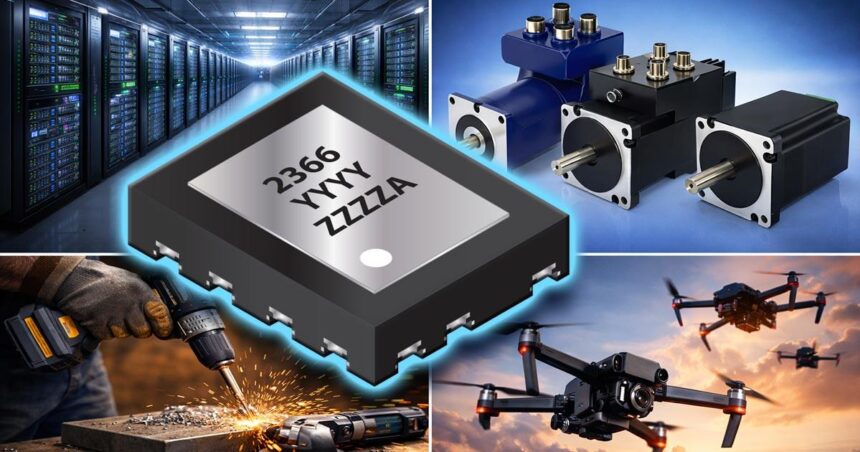
A tiny sliver of silicon carbide? Cute. But the real action in power electronics is gallium nitride, and EPC just dropped the hammer. The company has kicked off volume production of its first seventh-generation eGaN transistor, the EPC2366, and it’s making the old guard look ancient.
3x the Punch
EPC claims this 40V FET delivers up to three times the performance of equivalent silicon MOSFETs. That’s not marketing fluff—it’s physics. The secret sauce is a figure of merit (FoM) under 12 milliohm-nanocoulombs, which basically means it slashes both conduction and switching losses simultaneously. For engineers, that translates to cooler, denser power systems that don’t waste energy as heat.
The numbers back it up: 0.8 milliohm typical on-resistance, 88 amps continuous (360A pulsed), and a junction-to-case thermal resistance of just 0.6°C per watt. All packed into a 3.3mm x 2.6mm PQFN package. That’s the kind of spec sheet that makes data-center power supply designers salivate.
Where It Hurts
EPC is targeting the nastiest jobs in power conversion: synchronous rectification, high-density DC-DC, AI server power supplies, and advanced motor drives. The EPC2366 handles up to 48V transients, so it’s built for real-world abuse. CEO Alex Lidow notes this is just the opening salvo—25V and 15V Gen 7 parts are already sampling, with mass production expected by mid-2026.
To help engineers kick the tires, EPC is also shipping the EPC90167 half-bridge evaluation board. It’s a reference design with two EPC2366s in a low-parasitic layout, ready to accept standard PWM signals. At $211.65, it’s a cheap ticket to see if your next power stage can shrink by a factor of three.
The Bottom Line
At $1.56 each in volume, the EPC2366 isn’t cheap, but it’s a bargain if it lets you ditch a heatsink or double your power density. EPC is betting that Gen 7 eGaN will be the transistor that finally kills the silicon MOSFET in mid-voltage power conversion. With AI servers gobbling megawatts and motor drives demanding efficiency, that bet looks increasingly smart. The era of the power transistor as a commodity is over—the future is gallium nitride, and it’s shipping now.