
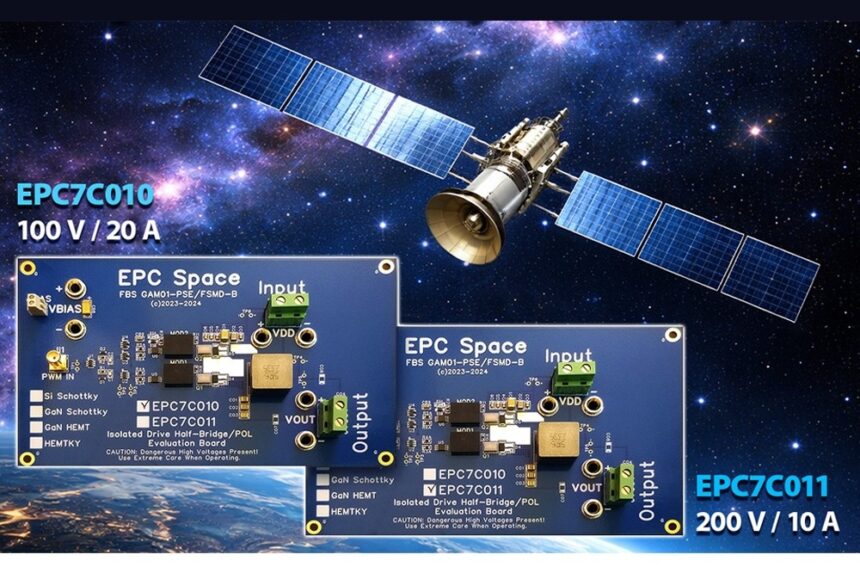
Long live the chip that can survive a nuclear blast. EPC Space just dropped a new line of radiation-hardened transistors that don’t just shrug off space radiation—they also fix one of the most annoying efficiency leaks in modern power electronics.
Meet the HEMTKY. It’s a high-electron-mobility transistor (HEMT) with a Schottky diode baked right onto the same piece of gallium nitride. Normally, when a GaN transistor runs in reverse—like in a half-bridge circuit—you lose energy to something called third quadrant conduction. The HEMTKY’s embedded anti-parallel diode eats those losses for breakfast.
The Schottky Shortcut
Here’s the jargon, stripped down: A Schottky diode is a fast-switching diode that doesn’t store charge like a regular diode. That means zero reverse recovery—the nasty current spike that happens when a standard diode turns off. For engineers designing power converters for satellites or lunar landers, this is a big deal. No reverse recovery means less heat, fewer timing headaches, and no need for an external diode cluttering up the board.
The first chip in the lineup, the EPC7052BSH, is a 100V, 30A device with a typical on-resistance of just 10 milliohms. It’s rated for a total ionizing dose over 1 megarad and can survive a single-event effect from a particle with a linear energy transfer of 85 MeV/(mg/cm²). In plain English: it can take a cosmic ray punch that would fry lesser components.
What This Means for Space
EPC Space CEO Bel Lazar says the HEMTKY lets designers cut power losses in hard-switching applications—where the device has to conduct high current in reverse for a moment. That’s every power converter, motor driver, or actuator in orbit. Less loss means smaller radiators, lighter power systems, and more payload for science.
Engineering samples run $212 each in 500-unit lots; space-qualified versions go for $315. That’s not cheap, but when your satellite is a billion-dollar asset, a few extra dollars per transistor is cheap insurance.
The kicker: This isn’t just for space. The same efficiency trick—monolithic integration of a Schottky diode—could trickle down to terrestrial applications like data center power supplies or EV inverters. Right now, it’s built for orbit. Tomorrow, it might be in your server rack.