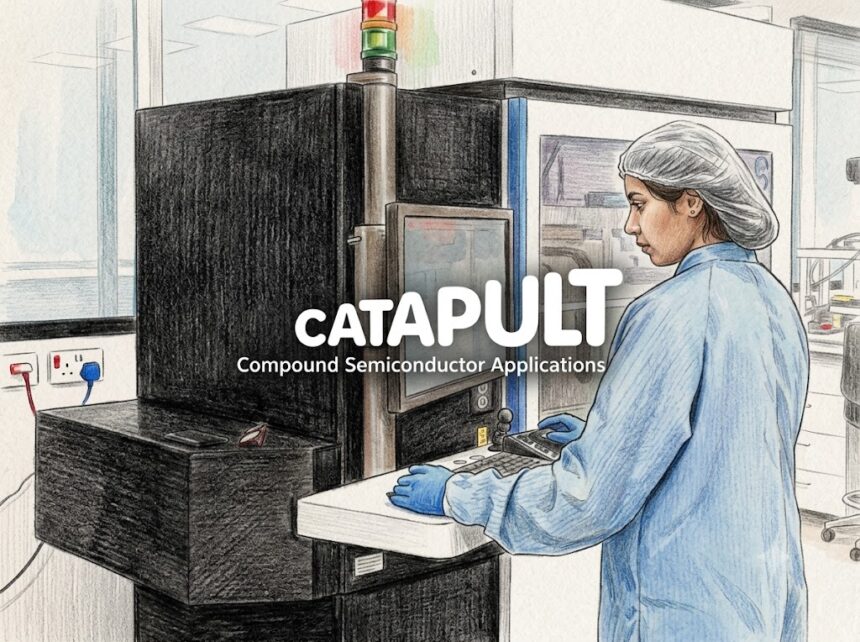
The UK’s Compound Semiconductor Applications (CSA) Catapult will transition this summer into the Semiconductor Catapult, a move directly responding to the government’s AI Hardware Plan and aimed at accelerating energy-efficient AI deployment in data centers and industry.
Background and strategic shift
Established in 2018 by Innovate UK, the CSA Catapult has served as a not-for-profit center of excellence specializing in compound semiconductor measurement, characterization, integration, and validation. Its focus spans power electronics, advanced packaging, radio frequency and microwave, and photonics applications.
The rebranding expands the organization’s mandate beyond compound semiconductors to cover the broader UK semiconductor sector. The Semiconductor Catapult will build on existing capabilities to support innovation from concept through commercialization, with a sharpened emphasis on energy-efficient, deployable systems for AI infrastructure.
Addressing the AI hardware bottleneck
Improving performance and energy efficiency in AI data centers remains a critical global challenge, according to CSA Catapult CEO Caroline O’Brien. “UK semiconductor companies have world-leading products and services that can be used in the hardware needed for AI data centers,” she stated.
The new Catapult aims to reduce risk for startups and enable them to leverage UK-anchored supply chains. By refocusing R&D efforts, the organization will work to increase adoption of UK-designed semiconductor technologies in AI infrastructure, including domestic data centers.
Government backing and industry impact
AI Minister Kanishka Narayan emphasized that the AI Hardware Plan is about backing British firms from early research through deployment. “One of the biggest challenges for UK chip companies is getting from a brilliant design to a product that is ready for market,” he noted.
The Semiconductor Catapult is designed to close that gap, supporting British firms in moving technology from the lab into production systems driving the AI revolution. The organization will continue its collaboration with the Department for Science, Innovation and Technology (DSIT) and Innovate UK.
Looking ahead
This transition signals a strategic pivot in UK semiconductor policy, prioritizing applied R&D that bridges fundamental research and commercial deployment. By broadening its scope while deepening its focus on energy efficiency, the Semiconductor Catapult positions itself as a central enabler for the UK’s ambition to lead in AI hardware. Success will depend on how effectively it translates government backing into tangible supply chain resilience and startup growth.