
BE Semiconductor Industries sold more machines in three months than it usually ships in half a year, and its shares are still down about 50 percent from a June peak.
Quarterly revenue rose 113.6 percent year on year to EUR 283.4M. Net income reached EUR 107.2M, up 323.7 percent. New orders of EUR 342.6M beat the EUR 298M consensus and ran ahead of revenue, a book-to-bill near 1.2.
It sits between the GPU and the memory
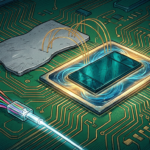
Hybrid bonding welds silicon faces directly instead of soldering stacked dies with tiny bumps. Data moves faster on less power, which is why co-packaged optics and logic chiplets adopted it first.
Bookings for those machines rose more than twofold in the first nine months of 2026 against all of last year. The company counts 23 customers with cumulative demand above 215 systems, and chief executive Richard Blickman credits faster co-packaged optics volume plus the start of edge AI production.
The high-bandwidth memory stack beside every AI accelerator is the market everyone assumed would follow. It has not.
Two dates the market keeps moving
Memory makers pushed the technique back in HBM, and the research firm SemiAnalysis sees die-to-wafer conversion slipping to 2029 or beyond. In October the same firm reported that ASML filed patent families for its own die-to-wafer tooling, the process where the Dutch supplier leads and where it has spent two decades serving TSMC and Intel.
Blickman disputes the framing, saying the two collaborate on placement precision and that ASML is no rival here.
Fourth-quarter revenue is guided roughly flat, with some customers pulling deliveries into the first half of 2027 to match their build plans. The orders stayed on the books.
The debate is not whether the packaging layer is booming. It is whether the memory half ever converts.