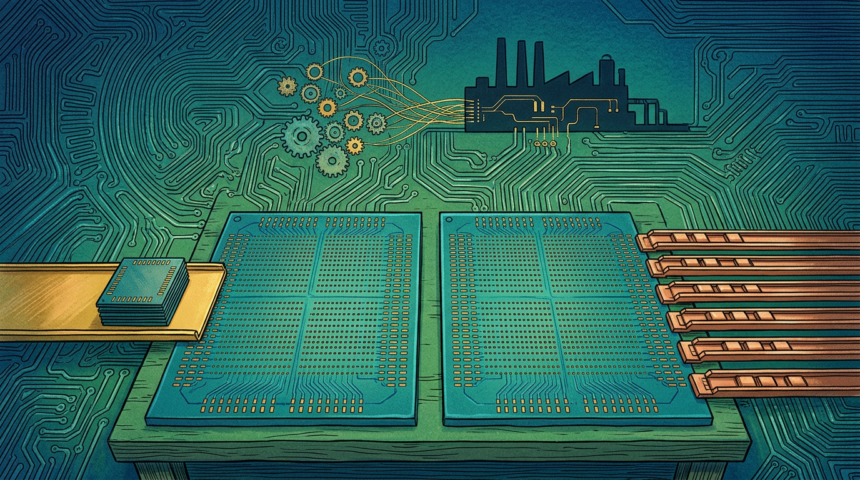
Samsung Electro-Mechanics has reportedly lined up KRW 3.7T from the two biggest buyers of AI silicon, money that pays for dedicated flip-chip ball grid array substrate lines rather than coming out of the chipmaker’s own budget.
The Maeil Business Newspaper report, carried by TrendForce and Taiwanese outlets on Oct 22, splits the funding unevenly. Tesla contributes roughly KRW 1.1T against a five-year supply agreement running from 2029 to 2033, covering substrates for its autonomous vehicles and Optimus humanoid robots. Nvidia accounts for about KRW 2.6T.
The Tesla money sits inside a KRW 4.27T Sejong expansion disclosed in September. Construction at the site should finish by the end of 2027, with tool installation and trial runs in the first half of 2028 and volume output in the second half. Deliveries to Tesla start the following year.
Nvidia’s share is harder to pin down. The company described the partnership at its Berlin event on Oct 21 but did not publish a figure, and the KRW 2.6T comes from the Korean press. Samsung Electro-Mechanics will run dedicated lines for AI compute and data center networking parts at Sejong and Busan.
The structural point is who now pays for capacity. High-end FC-BGA output is concentrated among a handful of suppliers, with Japan’s Ibiden holding the largest share by industry estimates and Taiwan’s Unimicron and the Korean firm chasing. Nvidia is spending advance payments across that group, including Ibiden’s Ono plant, as it works toward 2.5 times its current substrate capacity in three years.
For a component maker, a customer-funded line is cheaper capital than debt. For Tesla and Nvidia, it is a reservation fee on a part that has quietly become as hard to secure as wafer starts at an advanced node.