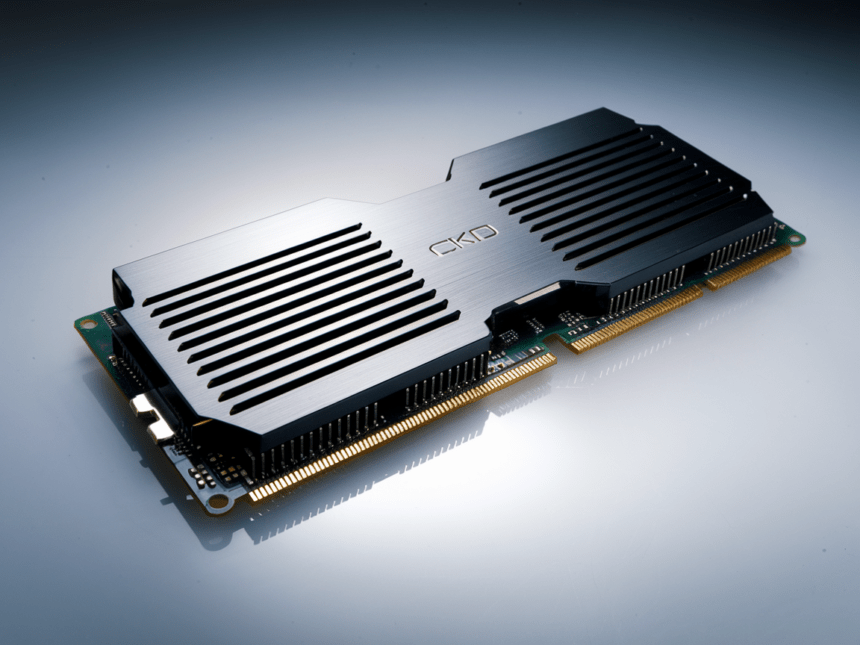
Rambus’s introduction of clocked DDR5 client memory modules (CKD DIMMs) marks a critical inflection point for AI-capable PCs, enabling data rates up to 9600 MT/s while maintaining signal integrity. This advance directly addresses the memory bandwidth bottleneck that throttles on-device AI inference and high-resolution graphics workloads.
What clocked DDR5 changes
Traditional DDR5 memory modules rely on the host CPU’s memory controller to drive all clock and data signals. At speeds beyond 6400 MT/s, signal degradation over the motherboard’s trace length becomes prohibitive. Clocked DDR5 modules integrate a dedicated clock driver directly on the DIMM, regenerating the clock signal near the DRAM chips. This reduces jitter and timing skew, allowing reliable operation at 9600 MT/s without costly re-engineering of the motherboard layout.
The solution is analogous to registered DIMMs (RDIMMs) used in servers, but optimized for the lower power and form-factor constraints of client platforms. Rambus’s implementation uses a single-chip clock driver that consumes under 0.5W, keeping thermal overhead negligible for thin-and-light laptops.
Power delivery and system management
Higher data rates demand tighter voltage regulation. Clocked DDR5 modules require a dedicated DC-DC converter to supply the clock driver’s 1.0V rail, separate from the DRAM’s 1.1V VDD. Rambus integrates this power management directly on the DIMM, ensuring stable voltage under transient loads from CPU memory accesses.
System-level firmware must also coordinate training sequences between the host memory controller and the CKD. Rambus provides a standardized interface for BIOS-level calibration, enabling plug-and-play compatibility with existing DDR5 platforms. This reduces integration risk for OEMs deploying AI PCs with next-generation CPUs.
Manufacturing and ecosystem readiness
Clocked DDR5 modules use standard DDR5 connectors and PCB layouts, requiring no changes to motherboard manufacturing processes. The clock driver itself is fabricated on a mature 28nm CMOS process, ensuring high yield and low cost. Rambus has already sampled the CKD to major memory module makers, with production qualification expected in Q3 2026.
The technology aligns with JEDEC’s DDR5 roadmap, which defines clocked DIMMs as a formal specification for speeds above 7200 MT/s. This ensures broad interoperability across DRAM vendors and CPU platforms from AMD, Intel, and others.
Forward-looking conclusion
Clocked DDR5 is not an incremental improvement—it is a prerequisite for AI PCs to deliver meaningful on-device performance. As neural processing units (NPUs) and discrete GPUs demand ever-higher memory bandwidth, the CKD architecture provides a scalable path from 6400 MT/s to 9600 MT/s and beyond. For enterprise buyers evaluating AI workstation deployments, this technology eliminates a key bottleneck without architectural overhauls, making 2026 the year high-bandwidth memory becomes standard in client systems.