Efficient Power Conversion (EPC) has commenced mass production of its EPC2378 25V eGaN power transistor, targeting efficiency gains in high-density DC-DC conversion for AI infrastructure and data centers.
Device specifications and performance
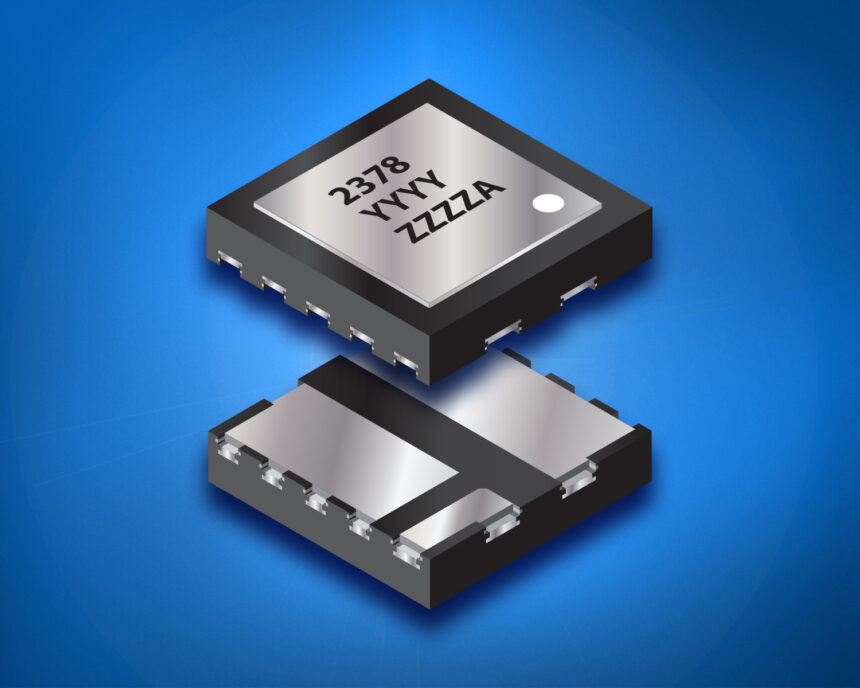
The EPC2378 is an enhancement-mode gallium nitride on silicon (eGaN) power FET optimized for synchronous rectifier applications on the secondary side of 48V-to-8V or 5V LLC converters. It delivers a typical on-resistance of 410µΩ, which EPC claims is best-in-class, combined with an industry-leading RDS(on) x QG figure of merit. This combination enables higher-frequency operation with lower switching losses.
The device supports continuous drain currents up to 101A, making it suitable for high-current, low-voltage power designs. It is packaged in a compact 3.3mm x 3.3mm PQFN footprint with a backside thermal pad, designed for superior thermal management in space-constrained applications.
Market relevance and applications
Rising demand for smaller, more efficient power conversion systems is driving adoption of wide-bandgap semiconductors. The EPC2378 addresses this need in fast-growth markets including AI infrastructure, data centers, telecom systems, industrial equipment, and advanced computing platforms. CEO Alex Lidow noted that the device combines very low conduction losses with excellent switching performance, enabling more compact system designs.
Development support and availability
To accelerate evaluation, EPC will introduce the EPC90185 development board. This platform integrates two EPC2378 transistors with a half-bridge gate driver, dead-time generation circuit, input capacitors, sense points, and high-current connectors. Engineers can use it to assess real-world performance in data-center power supplies, synchronous rectification stages, and motor drives.
The EPC2378 is priced at $2.40 per unit in 3,000-unit reels. The EPC90185 development board costs $226. Both are available for order through EPC’s global distribution channels, with deliveries from Digi-Key and Mouser expected by the end of June.
The EPC2378’s entry into mass production signals a practical step toward higher efficiency and power density in next-generation DC-DC conversion, particularly as AI workloads intensify demands on power infrastructure.