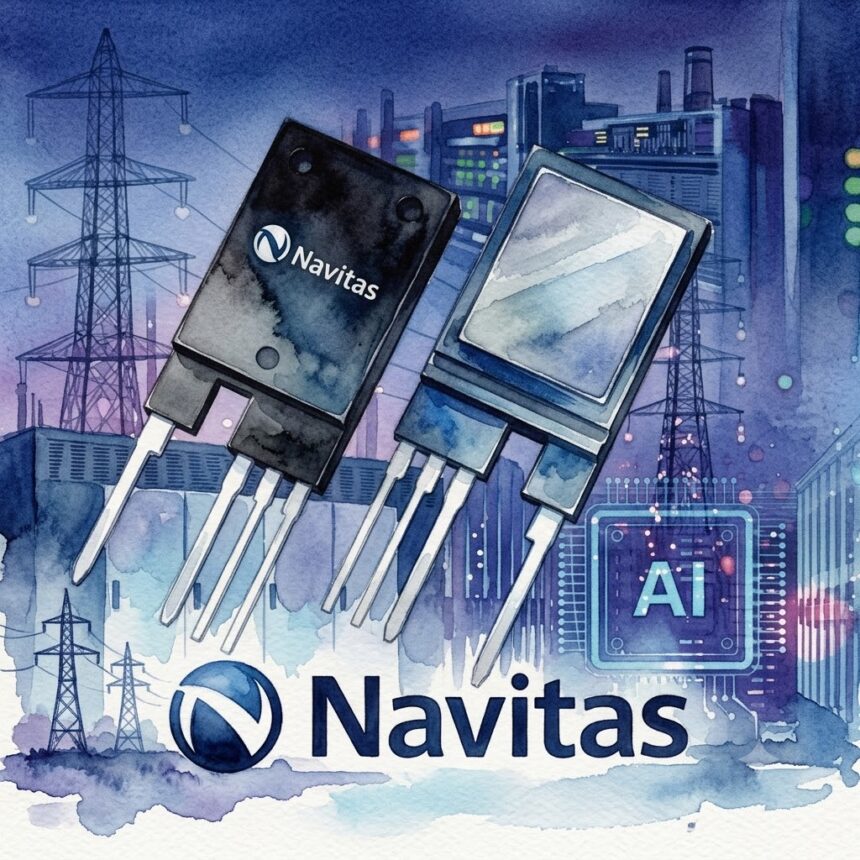
Navitas Semiconductor has introduced the UHV-TO-247-4-ISO package for its 1200V to 3300V GeneSiC SiC MOSFETs, targeting a new performance standard in high-voltage discrete power devices.
Package specifications and isolation
The new package delivers over 12mm pin-to-pin creepage and greater than 6000V integrated isolation, eliminating the need for external high-voltage isolation materials. This integrated approach simplifies system design while enabling module-like performance in a compact discrete form factor.
The package uses an aluminum nitride (AlN) substrate with active metal brazing (AMB) technology, providing robust isolation that exceeds 6000V. This design reduces die-to-heatsink stray capacitance compared to external ceramic isolators, lowering common-mode noise and radiated EMI.
Thermal and performance improvements
A key innovation is the direct-cooled, reflow-compatible thermal pad that mounts directly to liquid- or air-cooled heatsinks, removing the need for external thermal interface material (TIM). This reduces thermal resistance from junction to heatsink (RTH,J-HS) by up to 60%, enabling up to 150% increased power dissipation capability.
The package also demonstrates superior power and thermal cycling lifetime, built on the high-performance AlN substrate and robust reflow-compatible interface. By eliminating TIM and external isolation materials from the system stack, reliability improves while total system cost decreases.
Form factor and integration
The UHV-TO-247-4-ISO package maintains compatibility with the established high-voltage TO-247-4 form factor and lead geometry. This allows system designers to integrate the package without board redesign, while still achieving higher switching speeds, improved power density, and increased efficiency.
Navitas offers the package in 3300V, 2300V, and 1200V SiC MOSFET ratings. Target applications include high-voltage grid-tied power conversion systems, solid-state transformers, battery energy storage systems, and renewable energy installations.
Market positioning and significance
This packaging development addresses a fundamental challenge in high-power system design: balancing efficient thermal management with robust high-voltage isolation. As Paul Wheeler, VP and general manager of Navitas’ SiC business unit, noted, the package delivers power module-class performance in a compact discrete form factor, empowering designers for next-generation immersion-cooled and liquid-cooled power electronics.
The UHV-TO-247-4-ISO package represents a strategic advancement for Navitas, expanding its packaging portfolio alongside SiCPAK modules, QDPAK, and TO-247-LP solutions. For the power electronics industry, this package offers a practical path to more efficient, denser, and scalable systems in energy, grid, and AI data center applications.