Qunova Computing has been selected as one of only two non-Japanese organizations to join Japan’s JHPC-quantum Test User Program, granting it no-cost access to a world-leading hybrid quantum-classical computing platform.
Program details and access
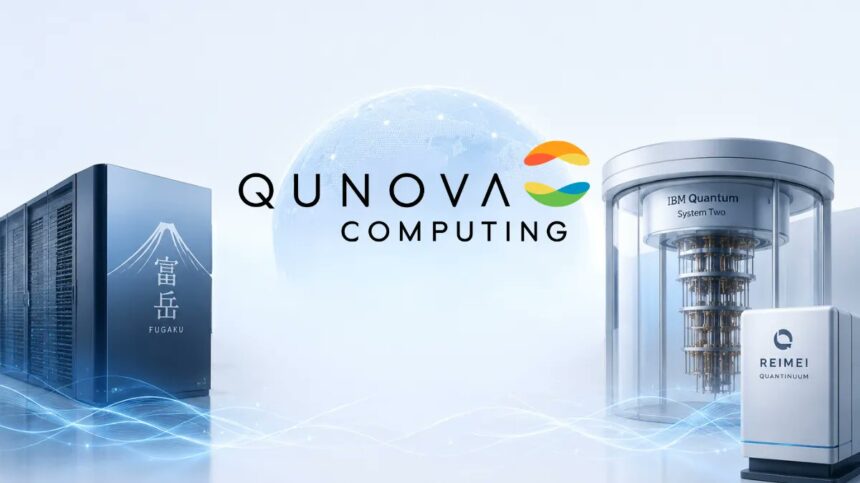
The agreement, formalized through a Memorandum of Understanding with JHPC-quantum, follows a competitive selection process evaluating scientific merit, technical feasibility, and hybrid quantum-HPC application potential. Qunova now gains access to the integrated platform combining the Fugaku supercomputer with an IBM Quantum System Two, one of the most powerful quantum-classical environments globally. Only 21 organizations were selected, with Qunova among two non-Japanese participants, underscoring international confidence in its quantum chemistry capabilities.
Technical focus and algorithm
Qunova applies its proprietary HI-VQE (Handover Iterative Variational Quantum Eigensolver) algorithm to computationally intractable problems in chemistry and materials science. A key benchmark is the iron-sulfur cluster, a test case with significant implications for materials discovery and drug development, representing a critical step toward demonstrating industrial quantum advantage. The HI-VQE algorithm is designed to efficiently partition workloads between classical supercomputers and quantum processors, maximizing the strengths of each.
Platform and ecosystem
The JHPC-quantum platform includes a superconducting quantum computer in Kobe (IBM Quantum System Two) and a trapped-ion quantum system in Wako (Quantinuum “Reimei”), making it one of the most comprehensive hybrid environments operational today. Led by RIKEN and SoftBank, the five-year initiative (November 2023–October 2028) aims to build an integrated national computing infrastructure connecting multiple supercomputers and quantum systems. For Qunova, the MoU opens direct access to Japan’s industrial quantum end-user ecosystem, accelerating its path to commercializing hybrid quantum applications in real-world chemistry.
Outlook
As JHPC-quantum moves toward commercial deployment by 2028, Qunova’s participation positions it at the forefront of hybrid quantum-HPC integration. The program’s emphasis on real-world industrial applications—spanning materials science, drug discovery, logistics, and finance—signals that practical quantum advantage is moving from theoretical promise to measurable engineering milestones.