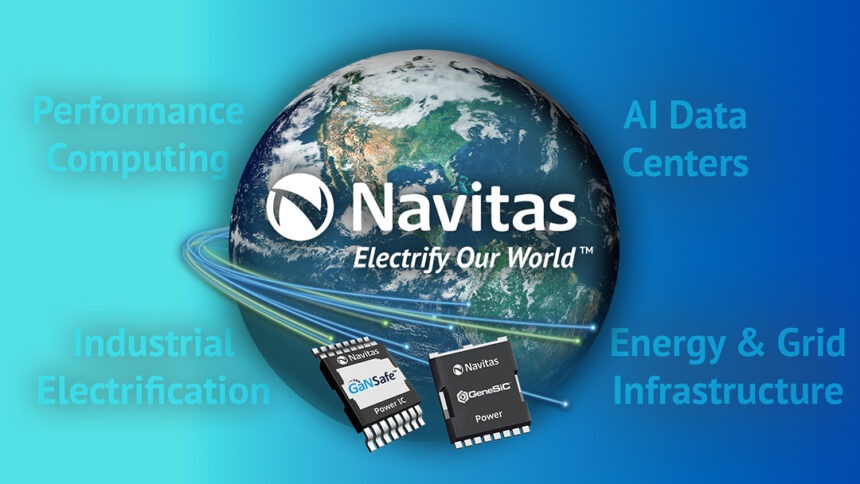
Navitas Semiconductor has joined the NVIDIA MGX ecosystem to accelerate the adoption of 800VDC rack architectures for next-generation AI data centers, addressing critical power delivery challenges in gigawatt-scale facilities.
Partnership and ecosystem context
At the NVIDIA Partner Ceremony during COMPUTEX 2026 in Taipei, Navitas demonstrated its 800V-to-6V DC-DC power delivery board (PDB) as part of the NVIDIA AI Factory MGX Ecosystem Showcase. The collaboration highlights a coordinated industry push toward open, modular AI infrastructure that can scale efficiently.
Navitas’ president and CEO Chris Allexandre stated that power delivery has become one of the most critical bottlenecks as AI workloads drive demand for compute at unprecedented scale. The company’s wide-bandgap (WBG) technologies—GaN and SiC—are positioned to enable megawatt-scale AI server racks with higher power density and improved thermal performance.
Technical breakthrough in power delivery
The PDB eliminates the conventional 48V intermediate bus converter (IBC) stage within compute server trays, directly converting 800V to 6V. This design maximizes system efficiency, reliability, and board real estate. The board uses 16 GaNFast FETs rated at 650V, 11mΩ, in a DFN8x8 dual-cooled package, achieving 97.5% peak efficiency at 1MHz switching frequency and a power density of 2100W/in³.
The board’s ultra-low profile—approximately 20% thinner than a mobile phone—enables close integration with GPU boards, improving transient performance and power distribution efficiency. This form factor is critical for dense AI compute racks where space and thermal management are paramount.
Full-stack wide-bandgap portfolio
Navitas provides a comprehensive WBG portfolio supporting the entire power chain from grid to GPU. Its GeneSiC silicon carbide solutions handle high-voltage stages, including 2300V and 3300V SiC power modules for solid-state transformers (SSTs) and 1200V Gen 5 SiC MOSFETs for three-phase power supply units (PSUs). These components ensure efficient power delivery from the grid to the rack level.
At the rack-to-GPU stage, GaNFast technology delivers high-frequency, high-efficiency DC-DC conversion. GaN’s superior switching performance enables MHz-frequency operation, faster transient response, and higher power density, allowing power to be delivered directly from the rack to the GPU without intermediate conversion losses.
Forward-looking significance
Navitas’ integration into the NVIDIA MGX ecosystem signals a structural shift in AI data center power architecture. By eliminating the 48V IBC stage and leveraging GaN and SiC at scale, the industry can move toward 800VDC racks that deliver higher efficiency, smaller footprints, and better thermal management. As AI factories scale from megawatts to gigawatts, this collaboration provides a technical blueprint for the next generation of power-dense, modular AI infrastructure.