
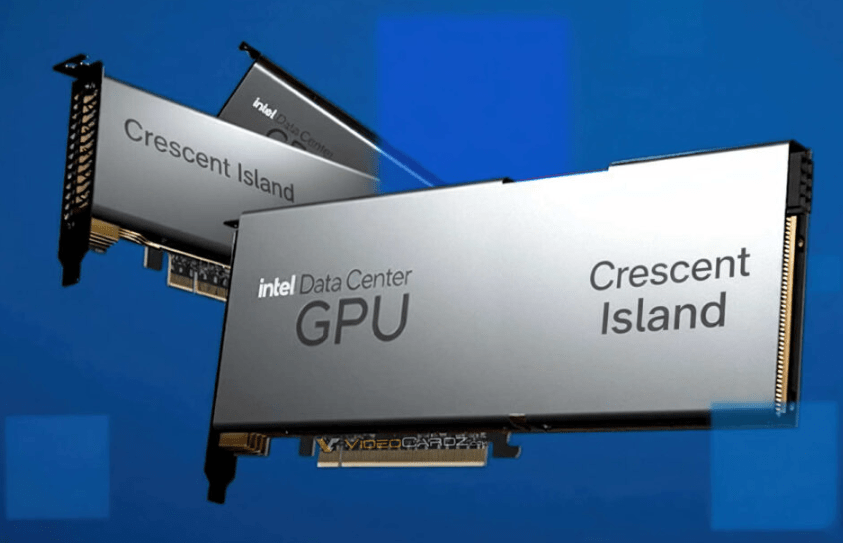
Intel unveiled its long-awaited Crescent Island AI inference GPU at Computex 2026, positioning it as a memory-capacity-focused alternative to conventional HBM-based accelerators.
Architecture and memory design
Crescent Island is built on Intel’s Xe3P architecture, described as “built for agentic AI.” It supports a broad data type range from FP4 for inference to FP64 for scientific computing, though Intel has not disclosed raw throughput specifications. The GPU is a 350W PCI Express add-in card, thermally comparable to Nvidia’s RTX Pro 5000 Blackwell.
The design diverges sharply from industry norms by using LPDDR5X instead of GDDR or HBM. Intel’s reference design includes 160GB, but partners can scale to 480GB. Leaks indicate a 640-bit bus connecting 20 LPDDR5X devices, likely 24GB modules from Samsung. At 10.7 Gbps, this yields approximately 684 GB/s of bandwidth.
Manufacturing and deployment advantages
Maximizing memory capacity with LPDDR5X reduces data movement by keeping more AI data local to the GPU, improving inference efficiency. Crucially, LPDDR5X avoids pressure on advanced packaging capacity and competition for scarce HBM, enabling more economical volume production. Intel has not disclosed fabrication details for the package itself.
The air-cooled, modest-power card fits standard 4U or 5U GPU servers, simplifying on-premise inference deployment. Eight fully configured accelerators with 480GB each would deliver 3.8 TB of local GPU memory, supporting large models or multiple AI agents in a single chassis.
Software ecosystem and timeline
Orchestrating multi-GPU workloads requires a capable software stack. Intel promotes its oneAPI framework, describing it as “open, upstreamed, and Day 0 ready” for Crescent Island. Adoption lags behind CUDA and ROCm, but early adopters will find a supported software path.
Intel targets a second-half 2026 launch. Crescent Island’s memory-centric approach and manufacturing flexibility could make it a compelling option for enterprises seeking cost-effective, on-premise AI inference—provided the software ecosystem matures in time.