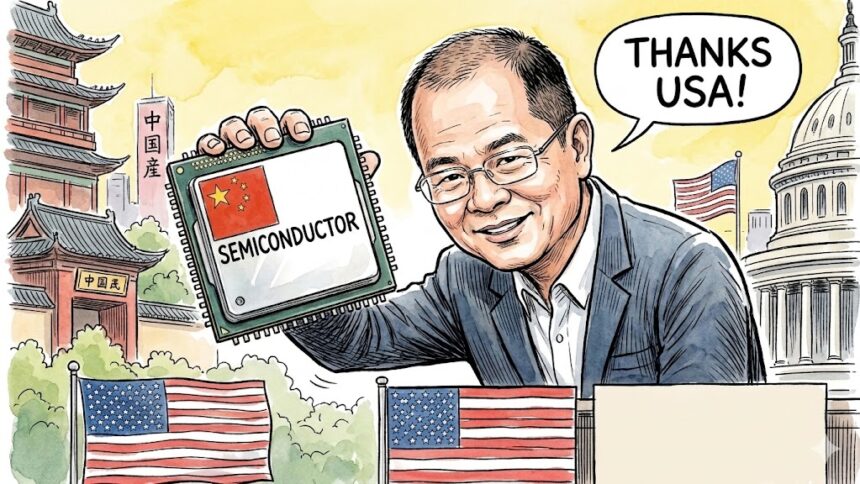
Huawei’s rotating chairman thanked the United States for chip export restrictions, crediting them with accelerating China’s semiconductor self-sufficiency.
Strategic gratitude
Xu Zhijun, Huawei’s rotating chairman, stated in a recent interview that U.S. export controls forced Chinese firms to invest in domestic R&D and build an independent tech stack. He described the pressure as a catalyst for breakthroughs like Huawei’s LogicFolding chip architecture, which the company unveiled earlier this year.
“If the United States hadn’t forced our country, our companies, and our industry, we wouldn’t have done something like this,” Xu said. He added that the sanctions have unified support across China’s semiconductor ecosystem.
Policy timeline and market impact
The U.S. first blacklisted Huawei in 2019 under the Trump administration. Biden-era controls in 2022 banned exports of Nvidia A100 and H100 GPUs, as well as AMD’s Instinct MI250 series, to China. Both vendors later produced lower-performance variants to comply, but Trump’s second-term complete export ban forced Nvidia to write off $5.5 billion in GPUs and cost AMD $800 million in sales.
A subsequent policy reversal allowed H200 chip exports with licensing and a 25% fee, but the landscape had already shifted. Chinese firms, unable to rely on U.S. hardware, turned to domestic alternatives.
Domestic acceleration
While some companies resorted to smuggling, the majority redirected procurement to local chipmakers. These domestic alternatives remain less power-efficient and slower than Nvidia or AMD offerings, but they provide a functional baseline. Increased revenue has enabled Chinese firms to reinvest in R&D, yielding chips that are now competitive on performance, though still lagging in efficiency.
Beijing reinforced this shift with direct orders for state-linked companies to purchase homegrown chips. Customs officials have blocked H200 AI chips and even the RTX 5090D V2 gaming GPU at the border.
Competitive consequences
Nvidia CEO Jensen Huang has long opposed export bans, arguing they force competitors to innovate. His prediction proved accurate: Nvidia’s AI chip market share in China dropped from 95% to effectively zero. Chinese AI firms continue to develop frontier models despite the hardware gap, maintaining competitive momentum against U.S. counterparts.
The bans delayed Chinese AI development by several years, but the forced pivot accelerated domestic innovation. Chinese firms are now producing viable alternatives that would not have emerged under open market conditions.
Forward outlook
The U.S. export controls have reshaped global semiconductor dynamics, transforming a dependent market into a competitive, self-reliant ecosystem. While Chinese chips still trail in efficiency and performance, the pace of improvement suggests the gap will narrow. For multinationals, the lesson is clear: export restrictions can create long-term competitors faster than market forces alone.