The AI data center has a bandwidth problem. Every GPU needs to talk to every other GPU at blistering speed, but the lasers that make that possible are bulky, expensive, and finicky. Now, a new chip from Xscape Photonics and Tower Semiconductor promises to kill the laser farm.
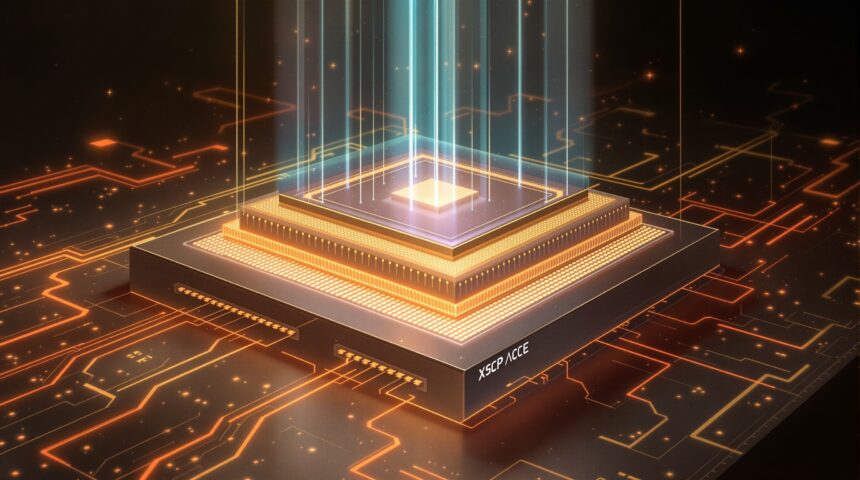
Built on Tower’s proven PH18 silicon photonics platform, this is the first on-chip, optically pumped, multi-wavelength laser source. Translation: instead of wiring up dozens of separate lasers for each color of light, you get a single chip that spits out a full rainbow of wavelengths—all powered by one external pump laser. It supports both CWDM and DWDM grids, the standard ways to pack multiple data channels onto a single fiber.
The Big Shift
The old way to build an optical interconnect was a nightmare of discrete components. You’d source multiple externally modulated lasers, then hybrid-integrate III-V materials onto a silicon chip—expensive, complex, and hard to scale. Xscape’s ChromX platform, based on its proprietary CombX technology, ditches all that. By monolithically embedding programmable multi-color lasers on-chip, it eliminates the need for hybrid integration entirely. That means lower cost, a simpler supply chain, and fewer things to break.
For AI clusters, this is huge. GPU-to-GPU and GPU-to-HBM links are the bottlenecks in hyperscale deployments. Every nanosecond of latency matters. By reducing component count and packaging complexity, Xscape’s solution cuts that latency and boosts bandwidth density. And because it’s built on Tower’s high-volume PH18 platform, it’s fully compatible with existing modulators and detectors—so current customers don’t need to redesign their whole stack.
What This Means
The numbers tell the story. LightCounting projects the optical transceiver market for AI clusters will double to over $10 billion by 2026, then hit $20 billion by 2030. That’s a lot of lasers. If Xscape and Tower can deliver on their promise of a manufacturable, scalable, monolithically integrated multi-color source, the days of the sprawling laser farm are numbered. The next generation of AI fabrics won’t just be faster—they’ll be simpler, cheaper, and built on a single chip. That’s the kind of shift that changes how you architect a data center.