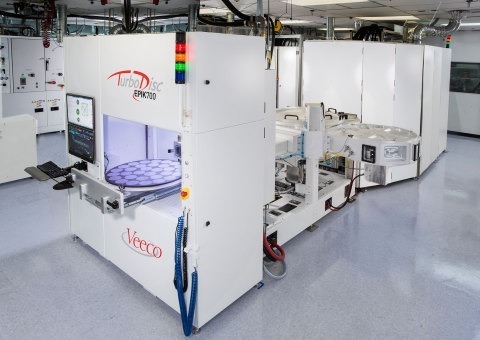
Veeco Instruments has locked in over $250 million in orders for the gear that makes indium phosphide (InP) lasers—the unsung heroes powering the optical interconnects in hyperscale data centers. Delivery starts this year, but the real surge hits in 2027.
The Photon Pipeline
These aren’t your granddad’s lasers. InP lasers are the workhorses for 800G and 1.6T optical transceivers—the kind that keep AI clusters from melting down. As copper cabling hits its thermal limits, data centers are going all-in on photonics. Veeco’s Spector ion beam deposition system applies those ultra-thin, low-absorption coatings on laser facets, a process that sounds fussy but is actually the difference between a laser that works and one that fizzles.
The company’s Lumina MOCVD platform grows the InP crystals themselves, using a TurboDisc reactor that promises uniformity and low defect rates. Meanwhile, the WaferEtch system handles the wet processing. Together, they’re a trifecta for a bottleneck that market analysts at LightCounting say is getting tighter by the quarter.
The Bottleneck Breaker
Here’s the problem: making InP lasers at scale is brutally hard. Qualified capacity is scarce, and the process integration is a nightmare of precision. Veeco’s senior VP Adrian Devasahayam frames it as a partnership story—some customers have been with them for over two decades. But the real news is that these orders are a bet on silicon photonics finally hitting its stride.
The takeaway? AI infrastructure isn’t just about GPUs and liquid cooling. The photonic backbone—the lasers, the coatings, the epitaxy—is where the real manufacturing crunch lives. Veeco just placed a very expensive marker on that future.