DRAM prices are skyrocketing, GPUs are hoarding HBM, and your servers are starving for RAM. Enter the “memory godbox”—a networked appliance that lets you pool and share memory across machines like it’s storage.
The tech behind it isn’t new. Compute Express Link (CXL) has been lurking for seven years, a cache-coherent interface that piggybacks on PCIe. Think of it as a universal translator for CPUs, memory, and accelerators. The 1.0 spec let you plug in memory expansion cards. The 2.0 spec added switching, so you could carve up a pool of RAM and assign slices to different servers. But it was clunky—unless you were truly memory-starved, you were better off just buying bigger DIMMs.
The real game-changer is CXL 3.0. It brings two things: fabric-level topologies (multiple switches linked together) and true memory sharing. Instead of partitioning RAM into isolated chunks, multiple machines can access the same data simultaneously. It’s like deduplication for memory, but across a rack. AMD’s next-gen Epycs and Intel’s Xeons will support it—Amazon’s Graviton5 already does.
Latency is the elephant in the room. CXL-attached memory adds about 170 to 250 nanoseconds—roughly a NUMA hop. Not terrible, but not local. Bandwidth, though, gets a boost from PCIe 6.0: 16 GB/s per lane, with CXL 4.0 doubling that to 32 GB/s on PCIe 7.0. That’s a firehose.
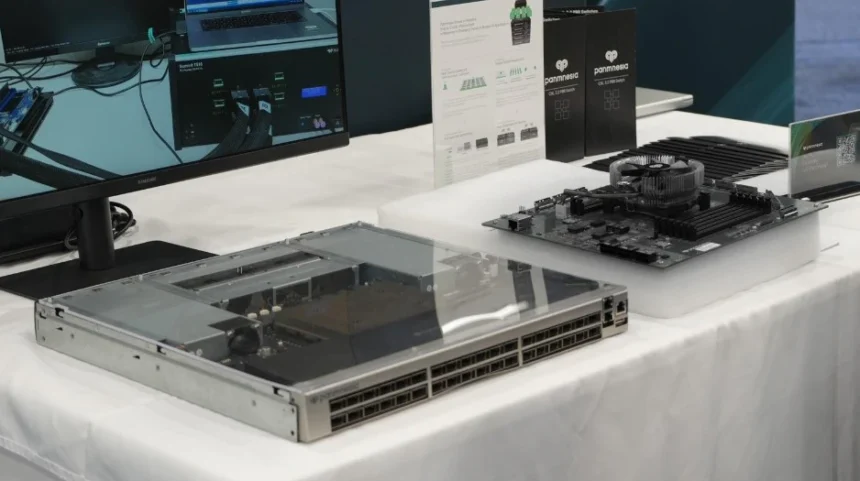
We’re already seeing hardware. Panmnesia’s PanSwitch offers 256 lanes of CXL 3.2 connectivity. Liqid’s platform pools up to 100 TB of DDR5 for 32 hosts. UnifabriX Max systems are shipping with CXL 2.0 today and 3.2 on the roadmap. Expect more godboxes as CXL 3.0 CPUs hit the market.
But here’s the kicker: the same memory shortage that makes these godboxes a lifeline is being driven by AI. During inference, GPUs offload massive key-value caches to system RAM. Those caches often dwarf the model itself. CXL vendors are pitching their boxes as a resilient alternative to flash storage, which wears out under constant writes. Translation: the RAMpocalypse isn’t going away. These godboxes might save your infrastructure budget, but only because AI is eating everything in sight.