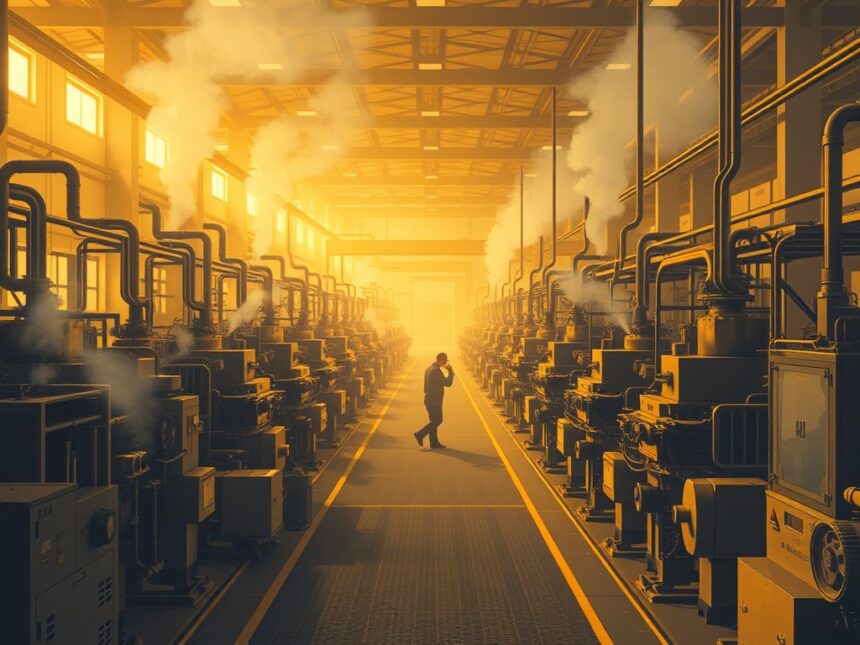
Sensors get clouded by pollutants. Airflow shifts unpredictably with every batch. Your readings might be off by half a percent—or 20 percent. And the difference between premium steel and expensive scrap hinges on decisions made from that shaky data.
This is the real world of industrial AI. Uncertainty isn’t a bug; it’s baked into the physics. The question isn’t whether AI *can* work here. It’s whether we can build systems that know what they don’t know—and act intelligently anyway.
Ninety-one percent of manufacturers have launched new AI projects in the past year, according to the American Supply Association. Yet the factory floor hasn’t crossed the threshold to real impact. The bottleneck isn’t hardware, bandwidth, or data volume. It’s uncertainty. And most AI crumbles when the inputs get noisy.
For decades, the fix was to eliminate uncertainty: cleaner environments, better sensors, tighter controls. That approach has hit its limits. The gap between AI’s promise and its actual impact traces to a single cause: most systems can’t operate intelligently when things get fuzzy.
Enter the “last mile” problem. Consider a vision system inspecting welds on an assembly line. Under perfect lighting, with parts in identical positions, it’s easy. But when lighting shifts, parts arrive at odd angles, or residue obscures the weld? The system faces a fundamentally different perceptual problem. For years, that demanded a human.
Scale that to a steel furnace. If airflow patterns shift due to equipment wear or batch changes, optimal parameters need to adjust. A system that can’t account for measurement uncertainty keeps running against a model that no longer matches reality.
The right approach isn’t eliminating uncertainty—it’s quantifying and managing it. That’s where Bayesian optimization and Monte Carlo methods come in. Bayesian systems maintain a probabilistic model of the environment, updating beliefs as new data arrives while explicitly representing what remains unknown. Monte Carlo methods simulate thousands of plausible scenarios, each weighted by likelihood.
But simulation alone isn’t enough. Running thousands of scenarios is only practical if each executes fast enough for real-time decisions. That’s where physics-native AI models change the game. Unlike black-box machine learning, these models encode the fundamental equations of heat transfer, fluid dynamics, and material behavior directly into the computation. They run orders of magnitude faster than traditional simulations—no specialized hardware or domain experts required.
Combined, these techniques let AI map the range of what could happen across all plausible conditions and identify the control actions most likely to succeed. The goal isn’t removing the chance of failure; it’s systematically improving the odds.
The pressure to solve this is intensifying. Global electricity demand from data centers is projected to more than double by 2030, roughly equal to Japan’s entire current power consumption. Managing a power grid’s web of inverters and transformers is exactly the kind of problem uncertainty-aware AI is built for. Same goes for fossil fuel production, where drilling a new well costs hundreds of millions and demands a 30-to-50-year return horizon. The global push to reshore manufacturing adds another driver: new factories that handle real-world variability without the workforce overhead older automation assumed.
The most damaging misconception is a false binary: either AI solves everything now, or it isn’t ready for serious use. Both miss the point. You can’t take AI off the shelf and apply it to a steel plant like you would an ad network. Industrial environments aren’t structurally similar at scale. The variability isn’t incidental—it’s the nature of manufacturing itself.
But that doesn’t mean the problem is unsolvable. Uncertainty-aware AI must be built from the ground up to acknowledge what it doesn’t know, explore what’s plausible, and make good decisions anyway.
When that capability matures, the gains won’t be incremental. Picture a steel plant where the control system doesn’t just react to sensor readings, but continuously asks: *Given what I know and what I don’t know, what’s the best action right now?* In that factory, a single operator oversees processes that once required a team—because AI absorbs the uncertainty that previously demanded constant human judgment. Unplanned downtime drops not by percentages, but by multiples. That’s the factory floor of 2030. And it’s closer than you think.