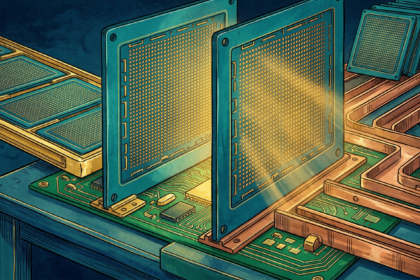

Nvidia is reportedly studying polytetrafluoroethylene, sold as Teflon, for the circuit boards that carry NVLink traffic between accelerators. The material wastes far less signal energy than the epoxy and hydrocarbon resins used in laminates today.
The physics is unforgiving at 200 Gb/s per lane. Co-packaged optics is not ready at the volumes Nvidia needs, so improving the board remains the most direct lever available. Industry sources cited in the report point to a Rubin Ultra switch board or an orthogonal mid-plane as candidates.
The case for PTFE is layer count. Boards are approaching 70 layers, and an analyst quoted in the report argues that even the top M9 grade falls short at that thickness, leaving fluoropolymer as the logical substitute.
The obstacles are manufacturing, not chemistry. PTFE’s non-stick property means it bonds poorly, so it cannot simply be laminated into a stack dozens of layers deep. It is also thin and soft, harder to drill cleanly and plate than resins that bond under heat.
Yields reportedly sit below 5 percent, which is the number that decides whether this ships. A material good enough on paper but unmanufacturable at scale would not reach production no matter how badly the interconnect needs it.
PTFE already appears in military radar, satellites and automotive radar, though mostly in antenna structures rather than dense digital boards. Wccftech rates the report plausible at 45 percent with thin corroboration.