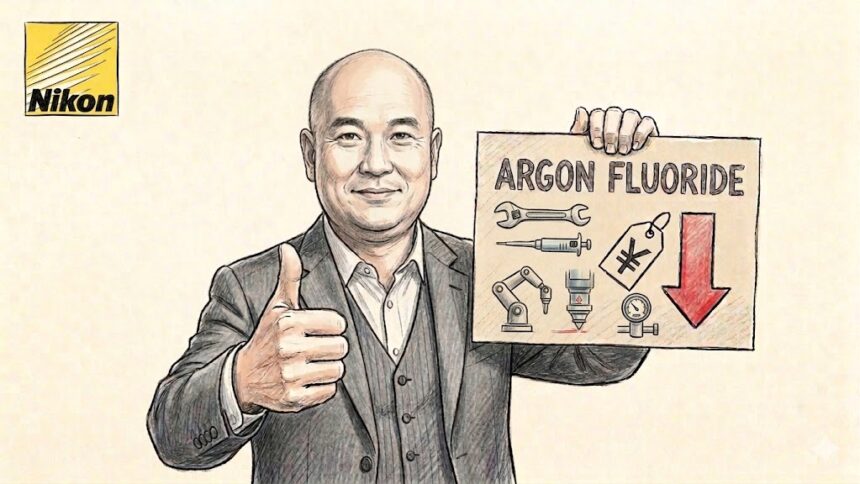
Nikon is challenging ASML’s lithography dominance by pricing its argon fluoride (ArF) tools below market leader ASML, leveraging in-house manufacturing to win back American and Asian chipmakers.
Strategic pricing move
Nikon president and CEO Yasuhiro Ohmura told Nikkei Asia that the company is in advanced discussions with several large U.S. and Asian chipmakers, with talks “nearing purchase orders.” The pricing strategy targets a segment where ASML does not hold an outright monopoly: ArF immersion systems, a mature deep ultraviolet (DUV) technology. Even on advanced 3nm chips, the majority of patterning steps still rely on ArF immersion tools.
ASML’s advanced ArF immersion machines average around $82.5 million per unit, leaving room for a cheaper rival. Nikon walked away from extreme ultraviolet (EUV) development in 2008, ceding that cutting-edge market entirely to ASML.
Manufacturing cost advantage
Nikon plans to launch a new ArF immersion platform in its 2028 fiscal year, featuring a new lens and wafer stage designed for compatibility with ASML’s installed base. “We manufacture many parts in-house, giving us an advantage in cost competition,” Ohmura said. This vertical integration allows Nikon to undercut ASML on price while maintaining margins.
Nikon and ASML are the only two companies building ArF lithography equipment. Demand is climbing as AI-driven chip production strains tool supplies. ASML shipped 48 EUV and 131 immersion DUV systems in 2025, closing the year with a €38.8 billion order backlog.
Market share challenges
Nikon’s ArF market share has steadily declined since ASML pulled ahead through long-term R&D partnerships and exclusive access to cutting-edge tooling. Intel, which once accounted for 80% of Nikon’s ArF orders, has cut spending amid its own manufacturing difficulties. Nikon shipped just 11 ArF systems in its fiscal year ending March 2024 and none across the first three quarters of its 2025 fiscal year.
The company posted a net loss of 86 billion yen ($540 million) for the year ended March, its worst ever, dragged down by weak equipment orders and a struggling metal 3D printing unit. Ohmura plans to narrow Nikon’s focus to cameras and chipmaking tools.
Forward outlook
Whether price alone will pull customers back remains uncertain. Chipmakers have long preferred dual sourcing to keep equipment costs in check, and Ohmura argues that reliance on a single supplier is unsustainable. If Nikon can deliver reliable, lower-cost ArF tools with ASML compatibility, it may carve out a meaningful share of the DUV market. However, rebuilding trust and reversing years of share loss will require more than aggressive pricing—it will demand consistent execution and proven performance in high-volume fabs.