
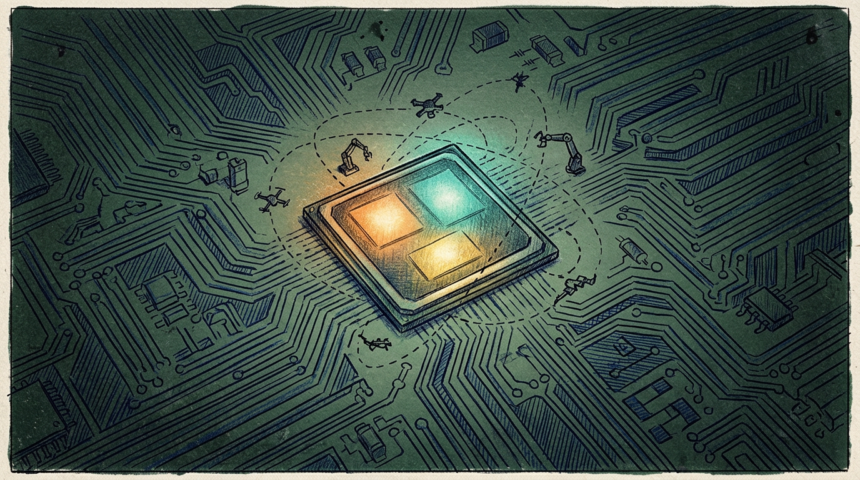
Ubitium, a German chip developer established in 2024, secured $14 million in seed capital to construct a unified processor handling sensing, inference and control for autonomous platforms.
Ibex Investors anchored the round. The financing included OpenOcean plus earlier backers KBC Focus Fund, Runa Capital and Inflection, bringing cumulative seed investment to $18 million. Florian Seibel, co-CEO at defense-technology company Quantum Systems, participated individually.
The target market falls under physical AI, the category spanning drones, robotics, industrial equipment and self-driving vehicles. Current architectures in these machines typically split responsibilities across a signal processor, a neural-processing unit or GPU, and a central processor managing control loops. Connecting those discrete components introduces latency, data-movement overhead and integration complexity.
Ubitium designed the device on a RISC-V foundation, arranging specialized logic into a single array of programmable elements. The company demonstrated the architecture in silicon within a year and plans to convert the design into a commercial product using the fresh capital.
Chief executive Hyun Shin Cho maintains that inference constitutes only one piece of the autonomy puzzle. Sensing the physical environment and executing real-time control are equally demanding, yet both presently rely on separate silicon.
Early customer engagements concentrate on sensing applications, including radar and acoustic systems requiring heavy signal processing alongside onboard AI. Seibel noted that autonomous machines must continue operating when communication links fail, within strict power and weight budgets.