
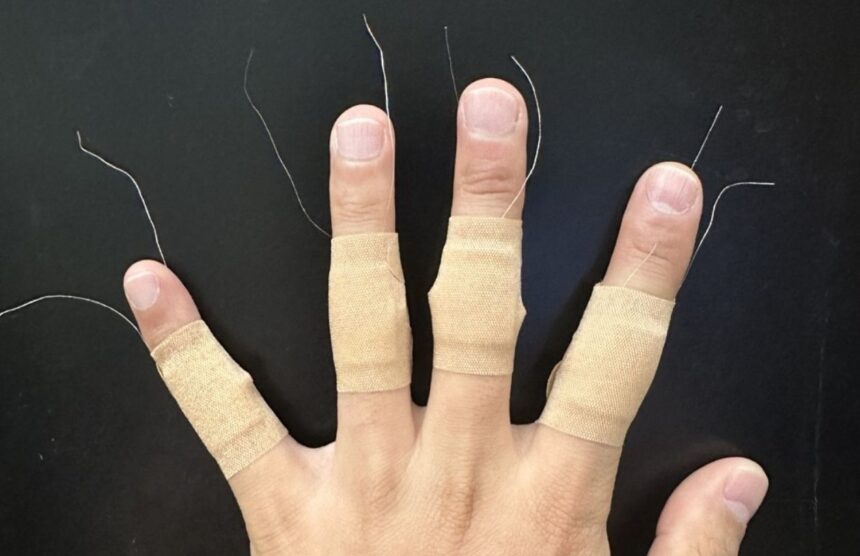
University of Houston engineers have developed paper-thin piezoelectric patch sensors that transform post-stroke hand rehabilitation into an interactive video game, addressing a critical gap in at-home care.
Sensor design and function
The sensors measure 5mm by 5mm and attach to the skin like bandages. They generate electric charges when bent or squeezed, converting finger and forearm muscle movements into voltage signals. These signals control on-screen commands for a rock-paper-scissors game, with win/loss outcomes determined by response time and movement accuracy.
The system detects subtle skin deformations from muscle contractions along the radial, median, and ulnar nerves. This enables precise recognition of hand gestures without bulky gloves, wristbands, or armbands required by conventional rehabilitation equipment.
Accessibility and independence
Current rehabilitation systems demand professional supervision and clinical settings, limiting patient access after hospital discharge. The new sensors enable self-driven therapy at home on the patient’s own schedule, requiring no specialist assistance. This addresses a critical gap: many stroke patients cannot sustain intensive rehab once discharged.
The sensors provide objective, quantifiable feedback—exact bending angles, response times, and movement accuracy—replacing subjective visual assessments by therapists.
Gamification and biocompatibility
Traditional rehabilitation feels repetitive and mechanical, leading to low patient participation. The rock-paper-scissors game integration adds engagement and self-motivation, making repetitive motor exercises sustainable. The system is self-powered, eliminating the need for batteries or external power sources.
Unlike many high-sensitivity piezoelectric sensors that contain toxic lead, the University of Houston team’s transducer is non-toxic, chemically stable, and biocompatible for prolonged wear. The device is designed to be barely felt when attached, creating a seamless interface for continuous monitoring.
Forward-looking significance
This technology represents a fundamental shift from clinic-bound, equipment-heavy rehabilitation to lightweight, self-directed therapy. By combining precise sensing, gamification, and biocompatible materials, it offers a scalable path to improved patient outcomes and reduced healthcare costs. If adopted widely, these sensors could redefine post-stroke care standards, making effective rehabilitation accessible anytime, anywhere.