
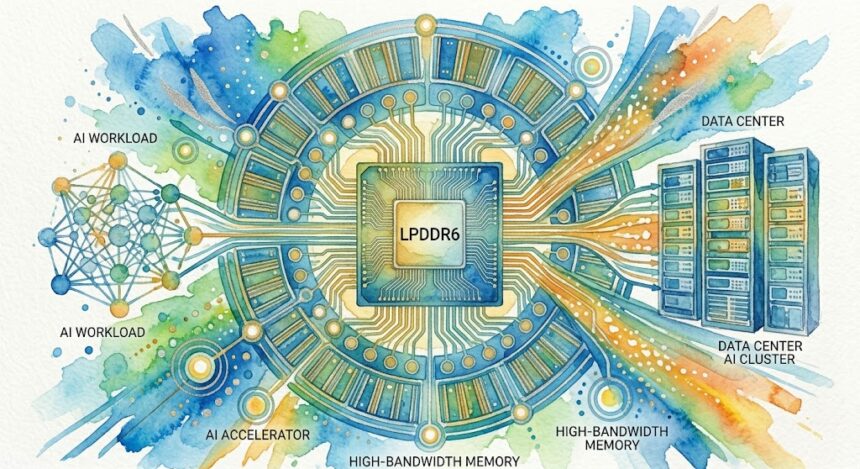
JEDEC’s forthcoming LPDDR6 revision adds features specifically for AI data centers, where the low-power memory standard is increasingly displacing traditional server DRAM.
Expanding beyond mobile
LPDDR has long been the memory of choice for smartphones, tablets, and ultra-thin laptops. That is changing. AI data centers—hungry for memory and sensitive to power budgets—are consuming large volumes of LPDDR supply.
The JC-42.6 Subcommittee released the foundational JESD209-6 standard in July 2025. The upcoming extension focuses squarely on data center and accelerated computing workloads, according to subcommittee chair Hung Vuong. “This revision will focus a lot of features on their needs,” he said.
Key technical changes
A narrower x6 per-die interface is the most significant architectural shift. Vice-chair Osamu Nagashima explained that this non-binary interface width enables higher capacities: “They can double the densities.” Bandwidth improves by 10–20% over the previous generation.
The update also introduces an additional x6 sub-channel mode, allowing more die per package and higher memory capacities per component and per channel. The target density is 512 GB, surpassing the current LPDDR5/5X maximum to support AI training and inference workloads.
SOCAMM and processing-in-memory
The revision includes an LPDDR6 SOCAMM2 module standard. SOCAMM modules offer 2.5× the bandwidth of conventional modules while consuming about one-third less energy, making them well-suited for AI systems with tight space and power constraints. Micron recently shipped a 256 GB LPDDR5X SOCAMM2 for AI infrastructure.
JEDEC is also finalizing an LPDDR6 processing-in-memory (PIM) standard. PIM embeds compute logic inside the memory chip, allowing calculations to occur in situ rather than moving data to the CPU or GPU. Nagashima noted this reduces data movement—the primary bottleneck for AI workloads—and lowers power consumption.
Industry momentum and outlook
LPDDR has been transitioning toward data center use for five years, moving from mobile-only to client computing as Dell, Lenovo, and HP adopted LPDDR5. Now, AI data centers are driving—and straining—the ecosystem. Vuong said most features are already defined: “We’re just crossing the Ts, dotting the Is.”
The LPDDR6 roadmap signals a fundamental shift: low-power memory is no longer a mobile niche. As AI workloads demand both bandwidth and energy efficiency, LPDDR6 is positioned to become a standard building block in the data center, reshaping memory architecture for the next generation of accelerated computing.