
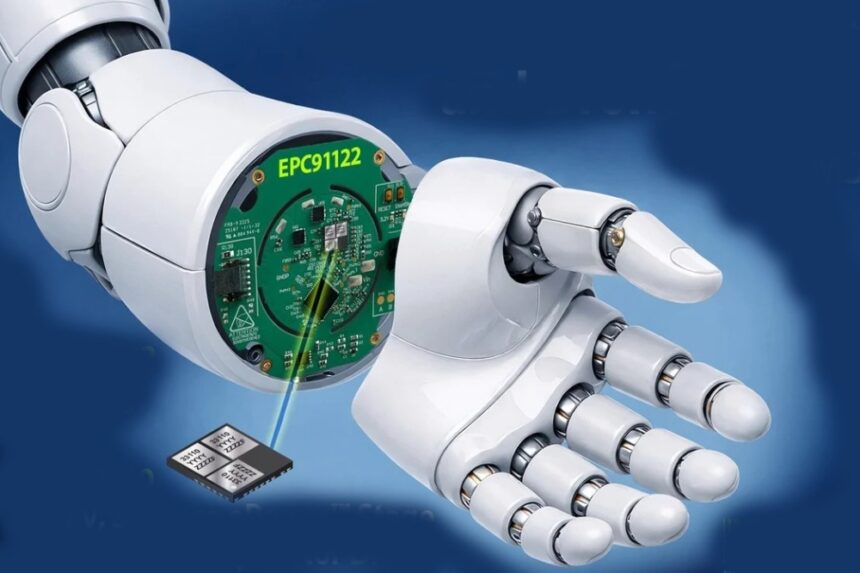
EPC just dropped a motor drive so compact and efficient it could be the secret sauce behind the next generation of humanoid joints and drone rotors. Meet the EPC91120, a three-phase BLDC inverter that fits in a 32mm circle—small enough to disappear inside a robot’s arm.
The GaN Inside
This isn’t your grandfather’s silicon motor controller. EPC packs three of its EPC23102 gallium nitride (GaN) half-bridge ICs onto a single board, paired with an onboard microcontroller, current sensors, and a magnetic encoder interface. GaN switches faster and wastes less heat than traditional silicon, which means the EPC91120 can handle 21A continuous (42A peak) at up to 55V DC—all while running a 100kHz PWM with a dead time of just 50 nanoseconds. That’s the kind of speed that lets a robot finger twitch with precision instead of lurch.
Built for the Joint
EPC designed this board with a specific target in mind: the Unitree A1 robot motor. It bolts directly into the motor housing, turning the metal casing into a heatsink. Under natural convection, it pushes 7A RMS per phase without breaking a sweat; inside that housing, it hits 15A RMS. Total system efficiency from DC input to mechanical output? Over 80 percent. For a robot joint that has to lift, pivot, and survive a tumble, that’s a big deal.
What This Means
“Lighter, faster, and smarter,” says CEO Alex Lidow. He’s not wrong. By embedding high-density inverter electronics directly into each motor joint, EPC is handing robotics engineers a shortcut to tighter torque control and lower weight. The reference board costs $394; the GaN chips themselves run $4.80 each in volume. That price point suggests GaN is no longer a lab curiosity—it’s a production-ready tool for the bots that will soon share our sidewalks. The question isn’t whether humanoid robots are coming. It’s whether they’ll be powered by yesterday’s silicon or tomorrow’s GaN.