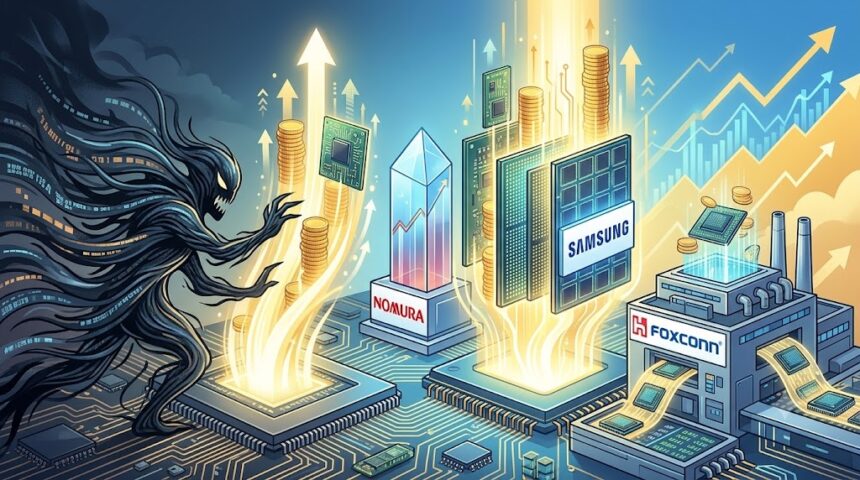
Three data points from Nomura, Samsung, and Hon Hai this week confirm that AI-driven memory demand remains robust, with supply constraints and strategic investments supporting a bullish outlook rather than signaling a downturn.
Market jitters and analyst reassessment
Recent volatility in global chip stocks — including a 5.8% single-day jump in the Kospi Index followed by a 9% selloff — had stoked fears of a slowdown in AI memory demand. Investors grew concerned after South Korean memory makers announced long-term investment plans totaling roughly 4.8 quadrillion won ($3.5 trillion), with 3.7 quadrillion won tied directly to memory projects. Meta’s plans to market surplus computing capacity further fueled speculation that AI hardware demand was weakening.
Nomura analysts have pushed back sharply against these fears. They argue the market is facing a severe shortage of high-bandwidth memory (HBM) driven by AI workloads, not oversupply. Producers are prioritizing high-margin HBM, leaving commodity DRAM and NAND supply constrained. The massive investment plans will not materially affect supply for years — the Yongin Semiconductor Cluster, launched nine years ago, will not begin small-scale production until late 2027. Meta’s move to monetize excess data-center capacity is a natural step for large platforms and could actually stimulate additional usage by lowering computing costs.
Samsung earnings as a bellwether
Samsung Electronics is expected to report an 18-fold profit jump when it releases earnings, driven by surging AI memory demand, particularly for HBM. Sell-side analysts remain bullish, with the average price target implying another 52% upside. Samsung and SK Hynix recently rallied over 8% in a single day, underscoring investor conviction that AI memory demand is accelerating, not cooling. The market is watching Samsung’s results closely as a key validation of the AI trade.
Hon Hai signals sustained hardware demand
Hon Hai Precision Industry Co (Foxconn), Nvidia’s server assembly partner, reported stronger-than-expected quarterly sales. Revenue grew 52.11% year-on-year to NT$821.8 billion (US$25.74 billion) in June, and second-quarter sales rose 39.83% year-on-year to NT$2.51 trillion, beating the NT$2.37 trillion analyst estimate. The company expects further quarterly and annual increases on the back of robust AI rack shipments and strong seasonal demand.
Hon Hai has established itself as a key AI hardware player, assembling servers housing Nvidia accelerators. Alphabet, Amazon, Meta, and Microsoft are setting aside about US$725 billion for AI spending this year. Although Hon Hai faces a shortage of memory chips used in products from smartphones to PCs and servers, executives say the crunch should not significantly impact demand for premium products.
Forward-looking implications
The convergence of Nomura’s supply-side analysis, Samsung’s earnings momentum, and Hon Hai’s revenue beat paints a clear picture: AI memory demand is not only holding but intensifying. Strategic long-term investments in semiconductor clusters will take years to bear fruit, while near-term HBM shortages and robust server buildouts will continue to drive revenue growth for memory makers and hardware assemblers alike. Investors should view recent volatility as a buying opportunity rather than a signal of an approaching trough.