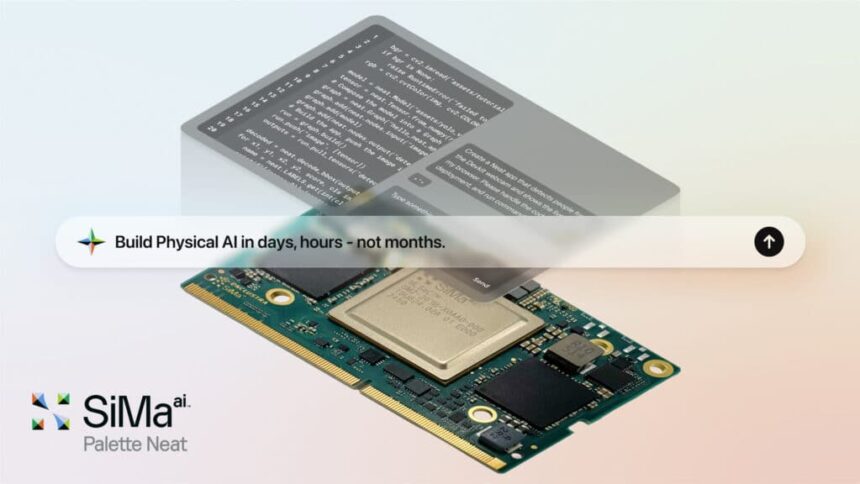
SiMa.ai has released Palette Neat, an agentic development environment that lets engineers design physical AI systems in plain English, cutting development from weeks to days or hours.
The productivity problem
Building AI for physical systems—robots, drones, medical devices, industrial automation—is far more complex than cloud AI. Developers must integrate front-end logic, multiple sensor modalities, data parsing, and pre- and post-processing pipelines. SiMa CEO Krishna Rangasayee told EE Times that typical customer teams spend six to twelve weeks writing code for such systems.
“If your software is poor, which unfortunately is the norm across the industry, sometimes it takes months to iterate,” he said. “We’re dismantling this barrier with Neat.”
How palette neat works
Palette Neat is part of SiMa’s existing Palette SDK. It combines an execution library with an agentic workflow that operates on top of SiMa’s Modalix MLSoC—a heterogeneous compute platform with Arm CPUs and an in-house NPU. Developers describe the system, its sensors, and constraints like accuracy and latency in natural language. The agent then designs an optimized AI pipeline for SiMa hardware.
The agents can also convert existing code from NVIDIA CUDA kernels. Rather than recompiling, the system analyzes what the CUDA code does and maps the mathematical operations to SiMa’s architecture. SiMa software product manager Manuel López Roldán explained: “It’s more like what a human would do—analyze what the CUDA code is doing, then figure out the best way of doing that mathematical operation with SiMa.”
Bridging the CUDA moat
Rangasayee argues that agentic code generation helps bridge NVIDIA’s perceived CUDA advantage. Agents iteratively explore every optimization path, often producing better code than human engineers. “Everybody now has access to the most expert engineering team you could get hold of, but you still stay at the abstraction layer of just describing a problem in English,” he said.
Crucially, the system does not operate as a black box. SiMa retains control over quality by training agents with specific skills and verifying outputs against known standards. The company maintains lower-level toolchain access in the Palette SDK for experienced developers who need it.
Market traction and automotive push
SiMa shipped approximately 1,000 production-qualified system-on-module (SoM) units last year. About 20 customers have already engaged with Palette Neat ahead of general availability. The SoM is pin-compatible with the NVIDIA Jetson Orin, easing migration. Through a partnership with Synopsys, SiMa’s AI hardware IP and toolchain are integrated into Synopsys’ architecture evaluation, simulation, and emulation platforms, targeting all major automotive OEMs.
Agentic AI has matured significantly in the last six months, Rangasayee noted, with trust and robustness improving. As physical AI scales beyond data center environments, the ability to abstract hardware complexity while preserving engineering control will determine which silicon platforms reach production fastest. SiMa’s bet is that speed to deployment, not peak teraflops, wins the embedded AI race.