
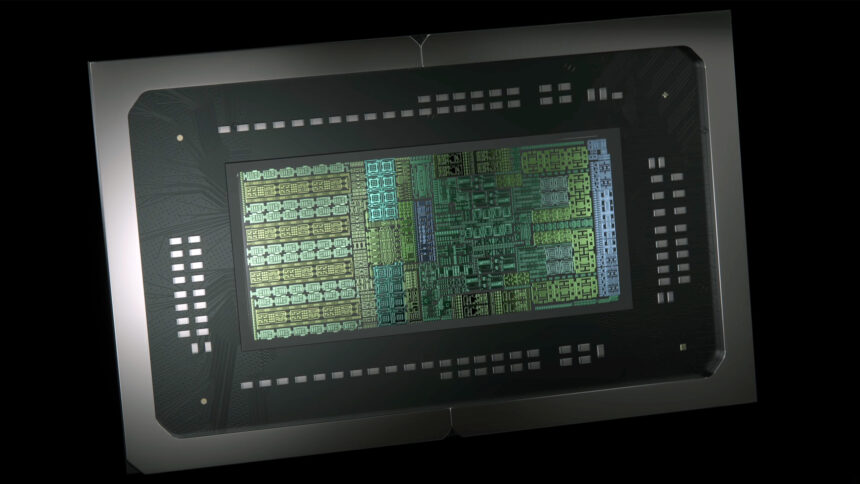
Nvidia is set to unveil its long-rumored N1 and N1X Arm-based SoCs at Computex, directly challenging AMD, Intel, and Apple in the laptop and edge-AI markets.
Specifications and SKU structure
The N1 family comprises two distinct tiers. The standard N1 ships in 12-core (8+4) and 10-core (7+3) configurations, with 2,560 and 2,048 CUDA cores respectively. Both variants support up to 64GB of LPDDR5X memory across eight channels and operate within an 18W–45W TDP envelope. PCIe connectivity includes eight Gen5 and three Gen4 lanes, supporting up to two M.2 SSDs.
The high-end N1X mirrors the GB10 silicon found in Nvidia’s DGX Spark mini-PC. It offers a 20-core (10+10) part with 6,144 CUDA cores—matching the desktop RTX 5070—and an 18-core (9+9) variant with 5,120 cores. Both N1X SKUs share a 45W–80W TDP range and support up to 128GB of LPDDR5X across 16 channels, with rumored speeds of 8,533 MT/s exceeding AMD’s Strix Halo. PCIe allocation increases to 12 Gen5 and five Gen4 lanes, enabling up to three M.2 SSDs.
Competitive positioning and market impact
These SoCs mark Nvidia’s return to the PC client market after its abortive 2011 Arm effort. The N1X is positioned to compete with Apple’s MacBook Pro in the $2,000+ segment, while the N1 targets midrange systems under $1,500. Unified memory architecture and CUDA compatibility give Nvidia a distinct advantage for AI workloads, though the N1’s 64GB memory cap and 128-bit bus may limit its appeal for serious inference tasks.
The launch has immediate implications for OEMs. Lenovo has already listed N1X-based Yoga Pro 7 configurations at approximately €3,000 for 32GB and €4,000 for 64GB, indicating premium pricing. Gaming performance remains secondary; the primary value proposition is AI acceleration in a power-constrained form factor.
Forward-looking significance
Nvidia’s entry into Arm-based client computing is a strategic pivot that could reshape the laptop SoC landscape. The combination of high-core-count Arm CPUs, substantial CUDA compute, and unified memory creates a platform uniquely suited for on-device AI, content creation, and developer workflows. Success will hinge on pricing discipline amid ongoing RAM cost inflation and on software ecosystem support—particularly native Arm game builds. If Nvidia executes, the N1 family could establish a new performance tier between traditional x86 laptops and Apple Silicon, forcing incumbents to accelerate their own Arm roadmaps.