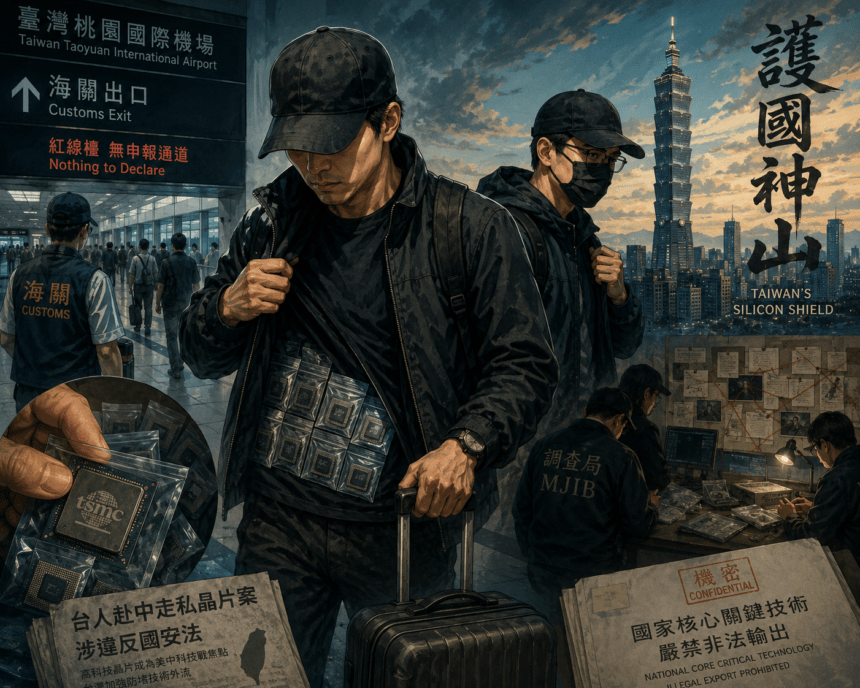
Taiwanese prosecutors raided 12 locations Wednesday and moved to detain three individuals in the island’s first formal criminal crackdown on illicit AI chip exports to China.
Enforcement Action
The Keelung District Prosecutors’ Office executed search warrants across multiple sites, targeting a scheme that allegedly used forged shipping documents to route approximately 50 AI servers manufactured by Super Micro Computer Inc. into China, Hong Kong, and Macau. The three fugitives face charges of document forgery and fraudulent declarations under local law, directly violating U.S. export controls on advanced semiconductor technology.
While the physical scale of this bust is modest—roughly 50 servers—the legal and political precedent is significant. Taiwan has long served as a transit hub for restricted hardware, with smugglers relying on lax local enforcement. This action signals a decisive policy shift under President Lai Ching-te, who faces mounting pressure from Washington to secure the global AI supply chain.
Broader Context
Super Micro is already at the center of the largest tech-evasion case in U.S. history. The Department of Justice recently indicted co-founder Wally Liaw for allegedly orchestrating a $2.5 billion smuggling ring that used front companies in Thailand to route restricted NVIDIA hardware to Chinese tech giants like Alibaba.
Taiwanese prosecutors claim this new case was initiated independently, but it targets the same vulnerability. Smugglers have exploited Taiwan’s position as a manufacturing and logistics hub, betting that compliance teams would look the other way. Using local forgery and fraud laws to prosecute such activity marks a dramatic escalation in enforcement posture.
Market Dynamics
The timing of the crackdown coincides with NVIDIA’s Q1 Fiscal 2027 earnings, which underscore the company’s decoupling from the Chinese market. NVIDIA reported $81.6 billion in total revenue—an 85% year-over-year increase—with $75.2 billion from its Data Center division alone, driven by insatiable demand for Blackwell architecture GPUs. Critically, management stated it is assuming zero data center compute revenue from China moving forward.
NVIDIA has effectively insulated its legal financial future from the Chinese market. The company does not need the revenue, and it does not need the regulatory exposure. For the black market, enforcement is tightening on multiple fronts.
Forward Outlook
When chip smuggling was solely a U.S. Department of Justice priority, enforcement was limited by geography. Now that key manufacturing and transit hubs—including Taiwan and Singapore—are actively prosecuting middlemen under local criminal fraud laws, the supply chain is fracturing. Getting banned Hopper or Blackwell chips into mainland data centers has become exponentially more difficult. This crackdown, while small in scale, signals a structural shift in enforcement that will reshape the illicit semiconductor trade for years to come.